


Page 27 - Read Online
P. 27
Page 14 of 38                            Zhu et al. Soft Sci 2024;4:17  https://dx.doi.org/10.20517/ss.2024.05


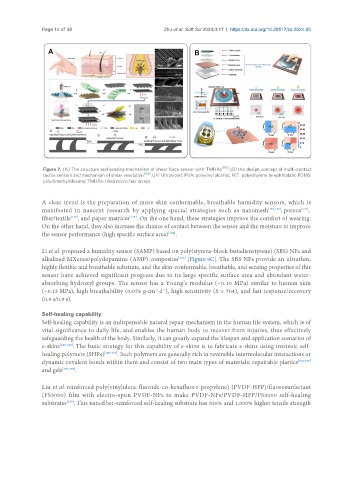
                Figure 7. (A) The structure and sensing mechanism of shear force sensor with  TMHAs [105] ; (B) the design concept of multi-contact
                tactile sensors and mechanism of shear resolution [106] . UV: Ultraviolet; PVA: polyvinyl alcohol; PET: polyethylene terephthalate; PDMS:
                polydimethylsiloxane; TMHAs: tilted micro-hair arrays.


               A clear trend is the preparation of more skin-conformable, breathable humidity sensors, which is
               manifested  in  nascent  research  by  applying  special  strategies  such  as  nanomesh [139,140] , porous ,
                                                                                                       [141]
                                             [143]
                         [142]
               fiber/textile , and paper matrices . On the one hand, these strategies improve the comfort of wearing.
               On the other hand, they also increase the chance of contact between the sensor and the moisture to improve
                                                          [144]
               the sensor performance (high specific surface area) .
               Li et al. proposed a humidity sensor (SAMP) based on poly(styrene-block-butadienstyrene) (SBS) NFs and
               alkalized MXenes/polydopamine (AMP) composites  [Figure 9C]. The SBS NFs provide an ultrathin,
                                                             [135]
               highly flexible and breathable substrate, and the skin-conformable, breathable, and sensing properties of this
               sensor have achieved significant progress due to its large specific surface area and abundant water-
               absorbing hydroxyl groups. The sensor has a Young’s modulus (~0.10 MPa) similar to human skin
               (~0.13 MPa), high breathability (0.078 g·cm ·d ), high sensitivity (S = 704), and fast response/recovery
                                                     -2
                                                        -1
               (0.9 s/0.9 s).

               Self-healing capability
               Self-healing capability is an indispensable natural repair mechanism in the human life system, which is of
               vital significance to daily life, and enables the human body to recover from injuries, thus effectively
               safeguarding the health of the body. Similarly, it can greatly expand the lifespan and application scenarios of
               e-skins [145-148] . The basic strategy for this capability of e-skins is to fabricate e-skins using intrinsic self-
               healing polymers (SHPs) [149-151] . Such polymers are generally rich in reversible intermolecular interactions or
               dynamic covalent bonds within them and consist of two main types of materials: repairable plastics [152-155]
               and gels [156-158] .


               Liu et al. reinforced poly(vinylidene fluoride-co-hexafluoro propylene) (PVDF-HFP)/fluorosurfactant
               (FS3000) film with electro-spun PVDF-NFs to make PVDF-NFs/PVDF-HFP/FS3000 self-healing
                       [159]
               substrates . This nanofiber-reinforced self-healing substrate has 836% and 1,000% higher tensile strength

