


Page 26 - Read Online
P. 26
Zhu et al. Soft Sci 2024;4:17  https://dx.doi.org/10.20517/ss.2024.05           Page 13 of 38


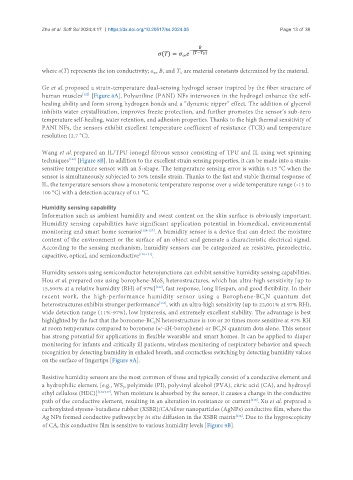
               where σ(T) represents the ion conductivity; σ , B, and T  are material constants determined by the material.
                                                              V
                                                     ∞
               Ge et al. proposed a strain-temperature dual-sensing hydrogel sensor inspired by the fiber structure of
                             [122]
               human muscles  [Figure 8A]. Polyaniline (PANI) NFs interwoven in the hydrogel enhance the self-
               healing ability and form strong hydrogen bonds and a “dynamic zipper” effect. The addition of glycerol
               inhibits water crystallization, improves freeze protection, and further promotes the sensor’s sub-zero
               temperature self-healing, water retention, and adhesion properties. Thanks to the high thermal sensitivity of
               PANI NFs, the sensors exhibit excellent temperature coefficient of resistance (TCR) and temperature
               resolution (2.7 °C).

               Wang et al. prepared an IL/TPU ionogel fibrous sensor consisting of TPU and IL using wet spinning
                        [123]
               techniques  [Figure 8B]. In addition to the excellent strain sensing properties, it can be made into a strain-
               sensitive temperature sensor with an S-shape. The temperature sensing error is within 0.15 °C when the
               sensor is simultaneously subjected to 30% tensile strain. Thanks to the fast and stable thermal response of
               IL, the temperature sensors show a monotonic temperature response over a wide temperature range (-15 to
               100 °C) with a detection accuracy of 0.1 °C.

               Humidity sensing capability
               Information such as ambient humidity and sweat content on the skin surface is obviously important.
               Humidity sensing capabilities have significant application potential in biomedical, environmental
               monitoring and smart home scenarios [124-127] . A humidity sensor is a device that can detect the moisture
               content of the environment or the surface of an object and generate a characteristic electrical signal.
               According to the sensing mechanism, humidity sensors can be categorized as: resistive, piezoelectric,
               capacitive, optical, and semiconductive [128-131] .

               Humidity sensors using semiconductor heterojunctions can exhibit sensitive humidity sensing capabilities.
               Hou et al. prepared one using borophene-MoS  heterostructures, which has ultra-high sensitivity [up to
                                                        2
                                                      [132]
               15,500% at a relative humidity (RH) of 97%] , fast response, long lifespan, and good flexibility. In their
               recent  work,  the  high-performance  humidity  sensor  using  a  Borophene-BC N  quantum  dot
                                                                                          2
                                                       [133]
               heterostructures exhibits stronger performance , with an ultra-high sensitivity (up to 22,001% at 97% RH),
               wide detection range (11%-97%), low hysteresis, and extremely excellent stability. The advantage is best
               highlighted by the fact that the boronene-BC N heterostructure is 100 or 20 times more sensitive at 97% RH
                                                     2
               at room temperature compared to boronene (α′-4H-borophene) or BC N quantum dots alone. This sensor
                                                                           2
               has strong potential for applications in flexible wearable and smart homes. It can be applied to diaper
               monitoring for infants and critically ill patients, wireless monitoring of respiratory behavior and speech
               recognition by detecting humidity in exhaled breath, and contactless switching by detecting humidity values
               on the surface of fingertips [Figure 9A].

               Resistive humidity sensors are the most common of these and typically consist of a conductive element and
               a hydrophilic element [e.g., WS , polyimide (PI), polyvinyl alcohol (PVA), citric acid (CA), and hydroxyl
                                          2
               ethyl cellulose (HEC)] [134-137] . When moisture is absorbed by the sensor, it causes a change in the conductive
               path of the conductive element, resulting in an alteration in resistance or current . Xu et al. prepared a
                                                                                     [138]
               carboxylated styrene-butadiene rubber (XSBR)/CA/silver nanoparticles (AgNPs) conductive film, where the
               Ag NPs formed conductive pathways by in situ diffusion in the XSBR matrix . Due to the hygroscopicity
                                                                                [134]
               of CA, this conductive film is sensitive to various humidity levels [Figure 9B].

