


Page 24 - Read Online
P. 24
Zhu et al. Soft Sci 2024;4:17  https://dx.doi.org/10.20517/ss.2024.05           Page 11 of 38


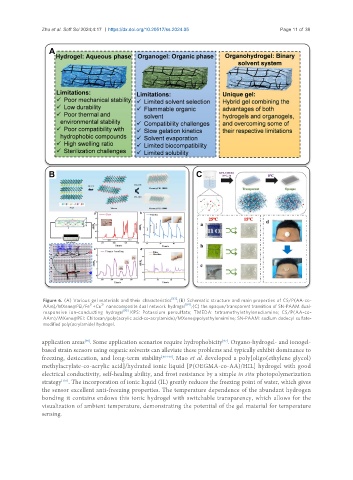
                Figure 6. (A) Various gel materials and their  characteristics [93] ; (B) Schematic structure and main properties of CS/P(AA-co-
                               3+
                                   2+
                AAm)/MXene@PEI/Fe +Cu  nanocomposite dual network  hydrogel [94] ; (C) the opaque/transparent transition of SN-PAAM dual-
                                           [95]
                responsive  ion-conducting  hydrogel  . KPS:  Potassium  persulfate;  TMEDA:  tetramethylethylenediamine;  CS/P(AA-co-
                AAm)/MXene@PEI: Chitosan/poly(acrylic acid-co-acrylamide)/MXene@polyethyleneimine; SN-PAAM: sodium dodecyl sulfate-
                modified poly(acrylamide) hydrogel.
               application areas . Some application scenarios require hydrophobicity . Organo-hydrogel- and ionogel-
                              [96]
                                                                            [97]
               based strain sensors using organic solvents can alleviate these problems and typically exhibit dominance to
               freezing, desiccation, and long-term stability [98-100] . Mao et al. developed a poly[oligo(ethylene glycol)
               methylacrylate-co-acrylic acid]/hydrated ionic liquid [P(OEGMA-co-AA)/HIL] hydrogel with good
               electrical conductivity, self-healing ability, and frost resistance by a simple in situ photopolymerization
               strategy . The incorporation of ionic liquid (IL) greatly reduces the freezing point of water, which gives
                      [101]
               the sensor excellent anti-freezing properties. The temperature dependence of the abundant hydrogen
               bonding it contains endows this ionic hydrogel with switchable transparency, which allows for the
               visualization of ambient temperature, demonstrating the potential of the gel material for temperature
               sensing.

