


Page 30 - Read Online
P. 30
Zhu et al. Soft Sci 2024;4:17  https://dx.doi.org/10.20517/ss.2024.05           Page 17 of 38


                                                                                         [159]
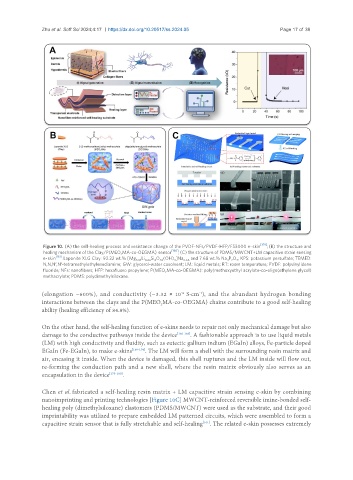
                Figure 10. (A) the self-healing process and resistance change of the PVDF-NFs/PVDF-HFP/FS3000 e-skin  ; (B) the structure and
                                                           [160]
                healing mechanism of the Clay/P(MEO MA-co-OEGMA) sensor  ; (C) the structure of PDMS/MWCNT+LM capacitive strain sensing
                                          2
                    [161]
                e-skin  . Laponite XLG Clay: 92.32 wt.% [Mg  Li  Si O (OH) ]Na   and 7.68 wt.% Na P O ; KPS: potassium persulfate; TEMED:
                                               5.34  0.66  8  20  4  0.66     4 2  7
                N,N,N′,N′-tetramethylethylenediamine; GW: glycerol-water cosolvent; LM: liquid metals; RT: room temperature; PVDF: polyvinylidene
                fluoride; NFs: nanofibers; HFP: hexafluoro propylene; P(MEO MA-co-OEGMA): poly(methoxyethyl acrylate-co-oligo(ethylene glycol)
                                                         2
                methacrylate; PDMS: polydimethylsiloxane.
                                                              -4
                                                                    -1
               (elongation ~600%), and conductivity (~3.32  × 10  S·cm ), and the abundant hydrogen bonding
               interactions between the clays and the P(MEO MA-co-OEGMA) chains contribute to a good self-healing
                                                       2
               ability (healing efficiency of 84.8%).
               On the other hand, the self-healing function of e-skins needs to repair not only mechanical damage but also
               damage to the conductive pathways inside the device [166-168] . A fashionable approach is to use liquid metals
               (LM) with high conductivity and fluidity, such as eutectic gallium indium (EGaIn) alloys, Fe-particle doped
               EGaIn (Fe-EGaIn), to make e-skins [169-174] . The LM will form a shell with the surrounding resin matrix and
               air, encasing it inside. When the device is damaged, this shell ruptures and the LM inside will flow out,
               re-forming the conduction path and a new shell, where the resin matrix obviously also serves as an
               encapsulation in the device [175-180] .


               Chen et al. fabricated a self-healing resin matrix + LM capacitive strain sensing e-skin by combining
               nanoimprinting and printing technologies [Figure 10C] MWCNT-reinforced reversible imine-bonded self-
               healing poly (dimethylsiloxane) elastomers (PDMS/MWCNT) were used as the substrate, and their good
               imprintability was utilized to prepare embedded LM patterned circuits, which were assembled to form a
                                                                     [161]
               capacitive strain sensor that is fully stretchable and self-healing . The related e-skin possesses extremely

