


Page 34 - Read Online
P. 34
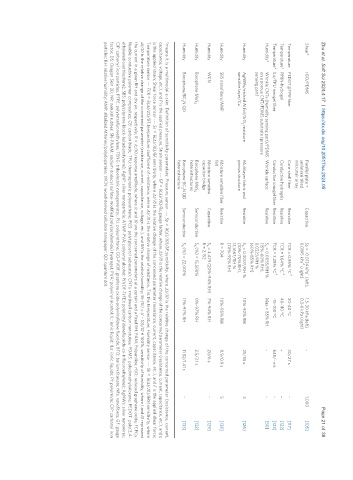
Zhu et al. Soft Sci 2024;4:17  https://dx.doi.org/10.20517/ss.2024.05                                                      Page 21 of 38

                                                                                             -1
                Shear*   rGO/PDMS                      Parallel plate +   Capacitive  Ss = -0.0134 kPa  (left),   1.5~30 kPa (left)   -  1,000  [105]
                                                                                          -1
                                                       unilateral tilted           0.0195 kPa  (right)  0.3~6 kPa (right)
                                                       microhair array
                                                                                             -1
                Temperature  PEDOT@TPU fiber           Core-shell fiber  Resistive  TCR = 0.95% °C   20~40 °C          30/27 s        -        [117]
                                                                                             -1
                Temperature* PPBN-hydrogel             Conductive hydrogels  Resistive  TCR = 1.64% °C  40~110 °C      -              -        [122]
                Temperature* ILs/TPU ionogel fiber     Conductive ionogel fiber Resistive  TCR = 3.28% °C -1  -15~100 °C  645/- ms    -        [123]
                Humidity*  Wrinkle CNTs (humidity sensing part)/PDMS  Wrinkle surface  Resistive  S  = 0.0055/RH %   Max = 85% RH  -  -        [50]
                                                                                   h
                         on a porous CNT/PDMS substrate (pressure                  (15%-60% RH),
                         sensing part)                                             0.0323/RH %
                                                                                   (60%-85% RH)
                Humidity  AgNWs/etched Al foil/SiO  moisture   Multilayer fabric and   Resistive  S  = 0.3007/RH %   10%~92% RH  25/55 s  3    [126]
                                          2                                        h
                         sensitive layer/Cu            porous structure            (10%~70% RH),
                                                                                   13.1667/RH %
                                                                                   (70%~92% RH)
                Humidity  SBS nanofibers/AMP           Moisture sensitive fiber  Resistive  R = 704  10%~95% RH        0.9/0.9 s      5        [138]
                                                       felt
                Humidity  WCN                          Moisture sensitive   Capacitive  S  = 4.479 (20%~94% RH)  7%-94% RH  20/6 s    -        [129]
                                                                                   h
                                                       capacitor bridge            R = 2,152
                Humidity  Borophene-MoS 2              Borophene-MoS   2  Semiconductive  S  (%) = 15,500%  0%~97% RH  2.5/3.1 s               [132]
                                                                                   h
                                                       heterostructures
                Humidity  Borophene/BC N QD            Borophene-BC N QD   Semiconductive  S  (%) = 22,001%  11%~97% RH  11.82/1.41 s  -       [133]
                                                                2
                                                                                   h
                                   2
                                                       heterostructure
               *means it is a multimodal e-skin. Definition of sensitivity parameters: Pressure sensor --- Sp =  δ(ΔJ/J0)/δP, sensitivity, where ΔJ/J0 is the relative change of the concerned parameter (resistance, current,
               capacitance, voltage, etc.), and P is the applied pressure; Strain sensor --- GF = δ(ΔJ/J0)/δε, gauge factor, where ΔJ/J0 is the relative change of the concerned parameter (resistance, current, capacitance, etc.), and ε
               is the applied strain; Shear force sensor --- Ss =  δ(ΔJ/J0)/δF, sensitivity, where ΔJ/J0 is the relative change of the concerned parameter (resistance, current, capacitance, etc.), and F is the applied shear force;
               Temperature sensor --- TCR = δ(ΔJ/J0)/δT, temperature coefficient of resistance, where ΔJ/J0 is the relative change of resistance, T is the temperature; Humidity sensor --- Sh = δ(ΔJ/J0)/δRH, sensitivity, where
               ΔJ/J0 is the relative change of the concerned parameter (resistance, current, capacitance, voltage, etc.), and RH is the relative humidity; Sh (%) = (I − I0)/I0 × 100%, sensitivity of humidity, where I and I0 represent
               the current in a given RH and dry air, respectively; R = Jc/J0, response amplitude, where Jc and J0 are the concerned parameters at a certain and a fixed RH. PANI: Polyaniline; rGO: reduced graphene oxide; FCPCs:
               flexible conductive polymer composites; CB: carbon black; TPU: thermoplastic polyurethane; PGS: poly(glycerol sebacate); CNTs: multiwall carbon nanotubes; PDMS: polydimethylsiloxane; PEDOT: poly(3,4-
               ethylenedioxythiophene); SBS: poly(styrene-block-butadienstyrene); AgNP: silver nanoparticle; ATMP-PVA: polyvinyl alcohol; P(VDF-TrFE): poly(vinylidenefluoride-co-trifluoroethylene); AgNWs: silver nanowires;
               CIP: carbonyl iron particles; PTFE: polytetrafluoroethylene; TENG: triboelectric nanogenerator; PU: polyurethane; GO-PVDF: graphene oxide-polyvinylidene fluoride; BTO: barium titanate; NFs: nanofibers; GF: gauge
               factor; DS: Dragon Skin 30; NR: natural rubber; SN-PAAM: sodium dodecyl sulfate-modified poly(acrylamide) hydrogel; PVA: polyvinyl alcohol; IL: ionic liquid; ILs: ionic liquids; PI: polyimide; CIP: carbonyl iron
               particles; RH: relative humidity; AMP: alkalized MXenes/polydopamine; WCN: wood-derived cellulose nanopaper; QD: quantum dot.

