


Page 37 - Read Online
P. 37
Page 24 of 38                            Zhu et al. Soft Sci 2024;4:17  https://dx.doi.org/10.20517/ss.2024.05


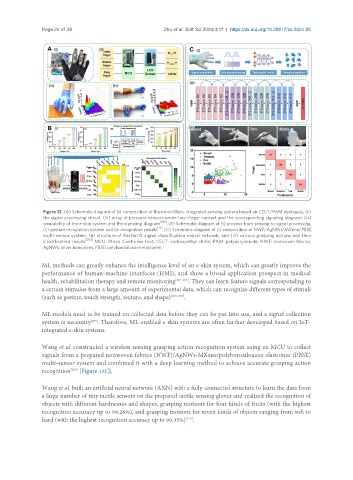
                Figure 12. (A) Schematic diagram of (i) composition of the monolithcic integrated sensing system based on CECT/PAM hydrogels, (ii)
                the signal processing circuit, (iii) array of pressure sensors under four-finger contact and the corresponding signaling diagram, (iv)
                wearability of the e-skin system and the signaling diagram [199] ; (B) Schematic diagram of (i) process from sensing to signal processing,
                (ii) gesture recognition system and its recognition results [13] ; (C) Schematic diagram of (i) composition of NWF/AgNWs-MXene/PBSE
                multi-sensor system, (ii) structure of ResNet18 signal classification neural network, and (iii) various grasping actions and their
                classification  results [200] . MCU: Micro-Controller Unit; CECT: carboxyethyl chitin; PAM: polyacrylamide; NWF: nonwoven fabrics;
                AgNWs: silver nanowires; PBSE: polyborosiloxane elastomer.

               ML methods can greatly enhance the intelligence level of an e-skin system, which can greatly improve the
               performance of human-machine interfaces (HMI), and show a broad application prospect in medical
               health, rehabilitation therapy and remote monitoring [201-204] . They can learn feature signals corresponding to
               a certain stimulus from a large amount of experimental data, which can recognize different types of stimuli
               (such as gesture, touch strength, texture, and shape) [205-208] .

               ML models need to be trained on collected data before they can be put into use, and a signal collection
               system is necessary . Therefore, ML-enabled e-skin systems are often further developed based on IoT-
                                [209]
               integrated e-skin systems.

               Wang et al. constructed a wireless sensing grasping action recognition system using an MCU to collect
               signals from a prepared nonwoven fabrics (NWF)/AgNWs-MXene/polyborosiloxane elastomer (PBSE)
               multi-sensor system and combined it with a deep learning method to achieve accurate grasping action
                         [200]
               recognition  [Figure 12C].

               Wang et al. built an artificial neural network (ANN) with a fully-connected structure to learn the data from
               a large number of tiny tactile sensors on the prepared tactile sensing gloves and realized the recognition of
               objects with different hardnesses and shapes, grasping motions for four kinds of fruits (with the highest
               recognition accuracy up to 99.26%), and grasping motions for seven kinds of objects ranging from soft to
                                                                [210]
               hard (with the highest recognition accuracy up to 99.35%) .

