


Page 36 - Read Online
P. 36
Zhu et al. Soft Sci 2024;4:17  https://dx.doi.org/10.20517/ss.2024.05           Page 23 of 38


                                                                                                  [195]
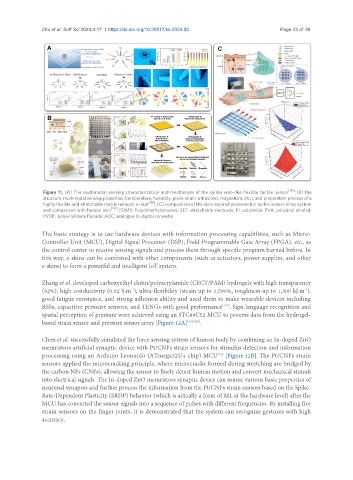
                Figure 11. (A) The multimodal sensing characterization and mechanism of the spider web-like flexible tactile  sensor  ; (B) the
                structure, multimodal sensing properties (temperature, humidity, plane strain, ultraviolet, magnetism, etc.), and preparation process of a
                                                   [196]
                highly flexible and stretchable matrix network e-skin  ; (C) composition of the skin-inspired piezoelectric tactile sensor array system
                                      [197]
                and comparison with human  skin  . PDMS: Polydimethylsiloxane; SET: stretchable electrode; PI: polyimide; PVA: polyvinyl alcohol;
                PVDF:  polyvinylidene fluoride; ADC: analogue-to-digital converter.
               The basic strategy is to use hardware devices with information processing capabilities, such as Micro-
               Controller Unit (MCU), Digital Signal Processor (DSP), Field-Programmable Gate Array (FPGA), etc., as
               the control center to receive sensing signals and process them through specific program burned before. In
               this way, e-skins can be combined with other components (such as actuators, power supplies, and other
               e-skins) to form a powerful and intelligent IoT system.


               Zhang et al. developed carboxyethyl chitin/polyacrylamide (CECT/PAM) hydrogels with high transparency
                                                                                                        -3
               (92%), high conductivity (0.62 S·m ), ultra-flexibility (strain up to 1,586%, toughness up to 1,300 kJ·m ),
                                             -1
               good fatigue resistance, and strong adhesion ability and used them to make wearable devices including
                                                                            [199]
               RSSs, capacitive pressure sensors, and TENGs with good performance . Sign language recognition and
               spatial perception of pressure were achieved using an STC89C52 MCU to process data from the hydrogel-
               based strain sensor and pressure sensor array [Figure 12A] [199,200] .


               Chen et al. successfully simulated the force sensing system of human body by combining an In-doped ZnO
               memristors artificial synaptic device with Pt/CNFs strain sensors for stimulus detection and information
               processing using an Arduino Leonardo (ATmega32U4 chip) MCU  [Figure 12B]. The Pt/CNFs strain
                                                                          [13]
               sensors applied the microcracking principle, where microcracks formed during stretching are bridged by
               the carbon NFs (CNFs), allowing the sensor to finely detect human motion and convert mechanical stimuli
               into electrical signals. The In-doped ZnO memristors synaptic device can mimic various basic properties of
               neuronal synapses and further process the information from the Pt/CNFs strain sensors based on the Spike-
               Rate-Dependent Plasticity (SRDP) behavior (which is actually a form of ML at the hardware level) after the
               MCU has converted the sensor signals into a sequence of pulses with different frequencies. By installing five
               strain sensors on the finger joints, it is demonstrated that the system can recognize gestures with high
               accuracy.

