


Page 17 - Read Online
P. 17
Page 4 of 38                             Zhu et al. Soft Sci 2024;4:17  https://dx.doi.org/10.20517/ss.2024.05


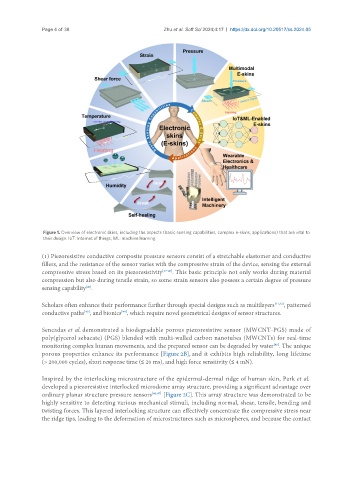
                Figure 1. Overview of electronic skins, including the aspects (basic sensing capabilities, complex e-skins, applications) that are vital to
                their design. IoT: Internet of things; ML: machine learning.

               (1) Piezoresistive conductive composite pressure sensors consist of a stretchable elastomer and conductive
               fillers, and the resistance of the sensor varies with the compressive strain of the device, sensing the external
               compressive stress based on its piezoresistivity [37-40] . This basic principle not only works during material
               compression but also during tensile strain, so some strain sensors also possess a certain degree of pressure
               sensing capability .
                              [40]
               Scholars often enhance their performance further through special designs such as multilayers [41,42] , patterned
               conductive paths , and bionics , which require novel geometrical designs of sensor structures.
                                          [44]
                             [43]
               Sencadas et al. demonstrated a biodegradable porous piezoresistive sensor (MWCNT-PGS) made of
               poly(glycerol sebacate) (PGS) blended with multi-walled carbon nanotubes (MWCNTs) for real-time
               monitoring complex human movements, and the prepared sensor can be degraded by water . The unique
                                                                                             [45]
               porous properties enhance its performance [Figure 2B], and it exhibits high reliability, long lifetime
               (> 200,000 cycles), short response time (≤ 20 ms), and high force sensitivity (≤ 4 mN).


               Inspired by the interlocking microstructure of the epidermal-dermal ridge of human skin, Park et al.
               developed a piezoresistive interlocked microdome array structure, providing a significant advantage over
               ordinary planar structure pressure sensors [46,47]  [Figure 2C]. This array structure was demonstrated to be
               highly sensitive to detecting various mechanical stimuli, including normal, shear, tensile, bending and
               twisting forces. This layered interlocking structure can effectively concentrate the compressive stress near
               the ridge tips, leading to the deformation of microstructures such as microspheres, and because the contact

