


Page 58 - Read Online
P. 58
Page 24 of 34                             Bai et al. Soft Sci 2023;3:40  https://dx.doi.org/10.20517/ss.2023.38

               temperature region. It has been verified that the hydrogel resistance decreased as a function of temperature
               from 25 to 70 °C. However, the stress could also affect the conductive path, so the stress variable should be
               controlled the same to detect the difference in temperature. For example, the hydrogel showed a logarithmic
               increase in resistance from fast to slow when exposed to the reagent at 5 °C, the opposite trend when
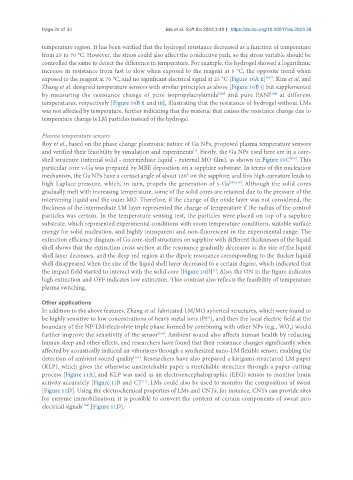
               exposed to the reagent at 70 °C, and no significant electrical signal at 25 °C [Figure 10A ii] . Kim et al. and
                                                                                           [207]
               Zhang et al. designed temperature sensors with similar principles as above [Figure 10B i] but supplemented
               by measuring the resistance change of pure isopropylacrylamide  and pure PANI  at different
                                                                                            [204]
                                                                           [208]
               temperatures, respectively [Figure 10B ii and iii], illustrating that the resistance of hydrogel without LMs
               was not affected by temperature, further indicating that the material that causes the resistance change due to
               temperature change is LM particles instead of the hydrogel.


               Plasma temperature sensors
               Roy et al., based on the phase change plasmonic nature of Ga NPs, proposed plasma temperature sensors
                                                                  [1]
               and verified their feasibility by simulation and experiments . Firstly, the Ga NPs used here are in a core-
               shell structure (internal solid - intermediate liquid - external MO film), as shown in Figure 10C . This
                                                                                                   [209]
               particular core γ-Ga was prepared by MBE deposition on a sapphire substrate. In terms of the nucleation
               mechanism, the Ga NPs have a contact angle of about 130° on the sapphire, and this high curvature leads to
               high Laplace pressure, which, in turn, propels the generation of γ-Ga [209,210] . Although the solid cores
               gradually melt with increasing temperature, some of the solid cores are retained due to the pressure of the
               intervening liquid and the outer MO. Therefore, if the change of the oxide layer was not considered, the
               thickness of the intermediate LM layer represented the change of temperature if the radius of the control
               particles was certain. In the temperature sensing test, the particles were placed on top of a sapphire
               substrate, which represented experimental conditions with room temperature conditions, suitable surface
               energy for solid nucleation, and highly transparent and non-fluorescent in the experimental range. The
               extinction efficiency diagram of Ga core-shell structures on sapphire with different thicknesses of the liquid
               shell shows that the extinction cross section at the resonance gradually decreases as the size of the liquid
               shell layer decreases, and the deep red region at the dipole resonance corresponding to the thicker liquid
               shell disappeared when the size of the liquid shell layer decreased to a certain degree, which indicated that
                                                                         [1]
               the impact field started to interact with the solid core [Figure 10D] . Also, the ON in the figure indicates
               high extinction and OFF indicates low extinction. This contrast also reflects the feasibility of temperature
               plasma switching.

               Other applications
               In addition to the above features, Zhang et al. fabricated LM/MO spherical structures, which were found to
               be highly sensitive to low concentrations of heavy metal ions (Pt ), and then the local electric field at the
                                                                       2+
               boundary of the NP/LM/electrolyte triple phase formed by combining with other NPs (e.g., WO ) would
                                                                                                   3
                                                      [168]
               further improve the sensitivity of the sensor . Ambient sound also affects human health by reducing
               human sleep and other effects, and researchers have found that their resistance changes significantly when
               affected by acoustically induced air vibrations through a synthesized nano-LM flexible sensor, enabling the
               detection of ambient sound quality . Researchers have also prepared a kirigami-structured LM paper
                                              [199]
               (KLP), which gives the otherwise unstretchable paper a stretchable structure through a paper-cutting
               process [Figure 11A], and KLP was used as an electroencephalographic (EEG) sensor to monitor brain
               activity accurately [Figure 11B and C] . LMs could also be used to monitor the composition of sweat
                                                [211]
               [Figure 11D]. Using the electrochemical properties of LMs and CNTs, for instance, CNTs can provide sites
               for enzyme immobilization; it is possible to convert the content of certain components of sweat into
               electrical signals  [Figure 11D].
                             [186]

