


Page 55 - Read Online
P. 55
Bai et al. Soft Sci 2023;3:40  https://dx.doi.org/10.20517/ss.2023.38            Page 21 of 34


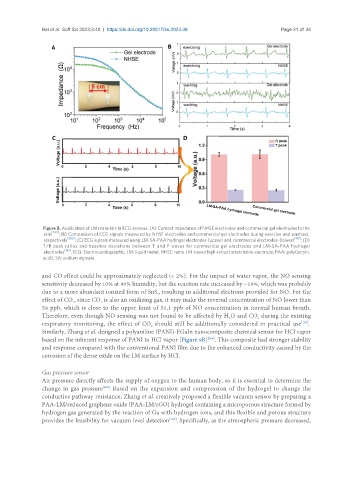
                Figure 8. Application of LM materials in ECG sensors. (A) Contact impedance of NHSE electrodes and commercial gel electrodes to the
                skin [203] ; (B) Comparison of ECG signals measured by NHSE electrodes and commercial gel electrodes during exercise and washout,
                respectively [203] ; (C) ECG signals measured using LM-SA-PAA hydrogel electrodes (upper) and commercial electrodes (lower) [192] ; (D)
                T/R  peak  ratios  and  baseline  deviations  between  T  and  P  waves  for  commercial  gel  electrodes  and  LM-SA-PAA  hydrogel
                electrodes [192] . ECG: Electrocardiographic; LM: liquid metal; NHSE: nano-LM-based high-robust stretchable electrode; PAA: poly(acrylic
                acid); SA: sodium alginate.

               and CO effect could be approximately neglected (< 2%). For the impact of water vapor, the NO sensing
               sensitivity decreased by 10% at 90% humidity, but the reaction rate increased by ~19%, which was probably
               due to a more abundant ionized form of SnS , resulting in additional electrons provided for NO. For the
                                                      2
               effect of CO , since CO  is also an oxidizing gas, it may make the reversal concentration of NO lower than
                                   2
                          2
               58 ppb, which is close to the upper limit of 51.1 ppb of NO concentration in normal human breath.
               Therefore, even though NO sensing was not found to be affected by H O and CO  during the existing
                                                                                        2
                                                                              2
               respiratory monitoring, the effect of CO  should still be additionally considered in practical use .
                                                                                                       [155]
                                                    2
               Similarly, Zhang et al. designed a polyaniline (PANI)-EGaIn nanocomposite chemical sensor for HCl vapor
               based on the inherent response of PANI to HCl vapor [Figure 9B] . This composite had stronger stability
                                                                       [204]
               and response compared with the conventional PANI film due to the enhanced conductivity caused by the
               corrosion of the dense oxide on the LM surface by HCl.
               Gas pressure sensor
               Air pressure directly affects the supply of oxygen to the human body, so it is essential to determine the
               change in gas pressure . Based on the expansion and compression of the hydrogel to change the
                                    [206]
               conductive pathway resistance, Zhang et al. creatively proposed a flexible vacuum sensor by preparing a
               PAA-LM/reduced graphene oxide (PAA-LM/rGO) hydrogel containing a microporous structure formed by
               hydrogen gas generated by the reaction of Ga with hydrogen ions, and this flexible and porous structure
               provides the feasibility for vacuum level detection . Specifically, as the atmospheric pressure decreased,
                                                          [189]

