


Page 54 - Read Online
P. 54
Page 20 of 34                             Bai et al. Soft Sci 2023;3:40  https://dx.doi.org/10.20517/ss.2023.38


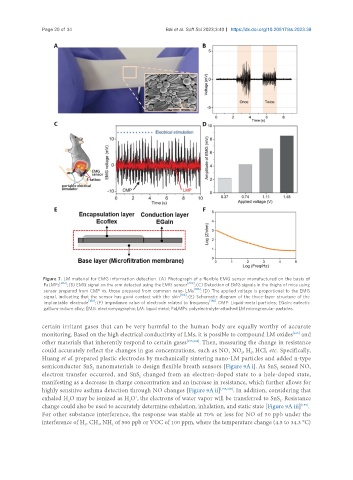
                Figure 7. LM material for EMG information detection. (A) Photograph of a flexible EMG sensor manufactured on the basis of
                PaLMPs [202] ; (B) EMG signal on the arm detected using the EMG  sensor [202] ; (C) Detection of EMG signals in the thighs of mice using
                sensor prepared from CMP vs. those prepared from common nano- LMs [186] ; (D) The applied voltage is proportional to the EMG
                signal, indicating that the sensor has good contact with the  skin [186] ; (E) Schematic diagram of the three-layer structure of the
                implantable  electrode [180] ; (F) Impedance value of electrode related to  frequency [180] . CMP: Liquid-metal particles; EGaIn: eutectic
                gallium-indium alloy; EMG: electromyographic; LM: liquid metal; PaLMPs: polyelectrolyte-attached LM microgranular-particles.


               certain irritant gases that can be very harmful to the human body are equally worthy of accurate
               monitoring. Based on the high electrical conductivity of LMs, it is possible to compound LM oxides  and
                                                                                                    [165]
               other materials that inherently respond to certain gases [155,204] . Then, measuring the change in resistance
               could accurately reflect the changes in gas concentrations, such as NO, NO , H , HCl, etc. Specifically,
                                                                                      2
                                                                                  2
               Huang et al. prepared plastic electrodes by mechanically sintering nano-LM particles and added n-type
               semiconductor SnS  nanomaterials to design flexible breath sensors [Figure 9A i]. As SnS  sensed NO,
                                2
                                                                                              2
               electron transfer occurred, and SnS  changed from an electron-doped state to a hole-doped state,
                                                2
               manifesting as a decrease in charge concentration and an increase in resistance, which further allows for
               highly sensitive asthma detection through NO changes [Figure 9A ii] [155,205] . In addition, considering that
                                               +
               exhaled H O may be ionized as H O , the electrons of water vapor will be transferred to SnS . Resistance
                                                                                               2
                                             2
                        2
               change could also be used to accurately determine exhalation, inhalation, and static state [Figure 9A iii] .
                                                                                                      [155]
               For other substance interference, the response was stable at 70% or less for NO of 50 ppb under the
               interference of H , CH , NH  of 500 ppb or VOC of 100 ppm, where the temperature change (4.5 to 34.3 °C)
                                  4
                              2
                                       3

