


Page 26 - Read Online
P. 26
Page 12 of 20                             Li et al. Soft Sci 2023;3:37  https://dx.doi.org/10.20517/ss.2023.30


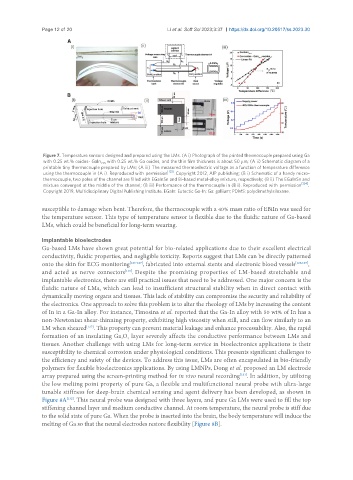
                Figure 7. Temperature sensors designed and prepared using the LMs. (A i) Photograph of the printed thermocouple prepared using Ga
                with 0.25 wt.% oxides- GaIn   with 0.25 wt.% Ga oxides, and the thin film thickness is about 50 μm; (A ii) Schematic diagram of a
                                   21.5
                printable tiny thermocouple prepared by LMs; (A iii) The measured thermoelectric voltage as a function of temperature difference
                                                          [123]
                using the thermocouple in (A i). Reproduced with  permission  . Copyright 2012, AIP publishing; (B i) Schematic of a handy micro-
                thermocouple, two poles of the channel are filled with EGaInSn and Bi-based metal-alloy mixture, respectively; (B ii) The EGaInSn and
                                                                                                       [124]
                mixture converged at the middle of the channel; (B iii) Performance of the thermocouple in (B i). Reproduced with  permission  .
                Copyright 2019, Multidisciplinary Digital Publishing Institute. EGaIn: Eutectic Ga-In; Ga: gallium; PDMS: polydimethylsiloxane.
               susceptible to damage when bent. Therefore, the thermocouple with a 40% mass ratio of EBiIn was used for
               the temperature sensor. This type of temperature sensor is flexible due to the fluidic nature of Ga-based
               LMs, which could be beneficial for long-term wearing.


               Implantable bioelectrodes
               Ga-based LMs have shown great potential for bio-related applications due to their excellent electrical
               conductivity, fluidic properties, and negligible toxicity. Reports suggest that LMs can be directly patterned
               onto the skin for ECG monitoring [125-127] , fabricated into external stents and electronic blood vessels [128,129] ,
               and acted as nerve connectors . Despite the promising properties of LM-based stretchable and
                                           [130]
               implantable electronics, there are still practical issues that need to be addressed. One major concern is the
               fluidic nature of LMs, which can lead to insufficient structural stability when in direct contact with
               dynamically moving organs and tissues. This lack of stability can compromise the security and reliability of
               the electronics. One approach to solve this problem is to alter the rheology of LMs by increasing the content
               of In in a Ga-In alloy. For instance, Timosina et al. reported that the Ga-In alloy with 50 wt% of In has a
               non-Newtonian shear-thinning property, exhibiting high viscosity when still, and can flow similarly to an
                              [127]
               LM when sheared . This property can prevent material leakage and enhance processability. Also, the rapid
               formation of an insulating Ga O  layer severely affects the conductive performance between LMs and
                                          2
                                            3
               tissues. Another challenge with using LMs for long-term service in bioelectronics applications is their
               susceptibility to chemical corrosion under physiological conditions. This presents significant challenges to
               the efficiency and safety of the devices. To address this issue, LMs are often encapsulated in bio-friendly
               polymers for flexible bioelectronics applications. By using LMNPs, Dong et al. proposed an LM electrode
               array prepared using the screen-printing method for in vivo neural recording . In addition, by utilizing
                                                                                  [131]
               the low melting point property of pure Ga, a flexible and multifunctional neural probe with ultra-large
               tunable stiffness for deep-brain chemical sensing and agent delivery has been developed, as shown in
               Figure 8A . This neural probe was designed with three layers, and pure Ga LMs were used to fill the top
                       [132]
               stiffening channel layer and medium conductive channel. At room temperature, the neural probe is stiff due
               to the solid state of pure Ga. When the probe is inserted into the brain, the body temperature will induce the
               melting of Ga so that the neural electrodes restore flexibility [Figure 8B].

