


Page 21 - Read Online
P. 21
Li et al. Soft Sci 2023;3:37  https://dx.doi.org/10.20517/ss.2023.30             Page 7 of 20


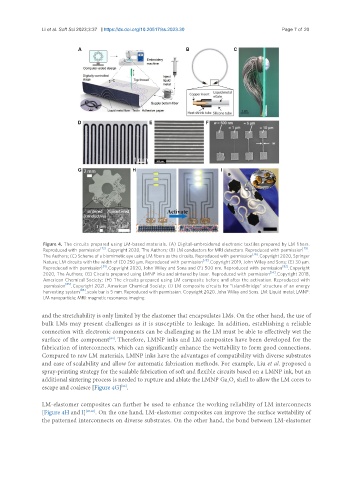
                Figure 4. The circuits prepared using LM-based materials. (A) Digital-embroidered electronic textiles prepared by LM fibers.
                                   [72]                                                                [75]
                Reproduced with permission  . Copyright 2020, The Authors; (B) LM conductors for MRI detectors. Reproduced with permission  .
                                                                                      [76]
                The Authors; (C) Scheme of a biomimetic eye using LM fibers as the circuits. Reproduced with permission  . Copyright 2020, Springer
                Nature; LM circuits with the width of (D) 250 μm. Reproduced with permission [78] . Copyright 2019, John Wiley and Sons; (E) 30 μm.
                Reproduced with  permission [81] . Copyright 2020, John Wiley and Sons and (F) 500 nm. Reproduced with  permission [82] . Copyright
                2020, The Authors; (G) Circuits prepared using LMNP inks and sintered by laser. Reproduced with  permission [55] . Copyright 2018,
                American Chemical Society; (H) The circuits prepared using LM composite before and after the activation. Reproduced with
                permission [85] . Copyright 2021, American Chemical Society; (I) LM composite circuits for “Island-bridge” structure of an energy
                harvesting system [86] , scale bar is 5 mm. Reproduced with permission. Copyright 2020, John Wiley and Sons. LM: Liquid metal; LMNP:
                LM nanoparticle; MRI: magnetic resonance imaging.


               and the stretchability is only limited by the elastomer that encapsulates LMs. On the other hand, the use of
               bulk LMs may present challenges as it is susceptible to leakage. In addition, establishing a reliable
               connection with electronic components can be challenging as the LM must be able to effectively wet the
                                      [84]
               surface of the component . Therefore, LMNP inks and LM composites have been developed for the
               fabrication of interconnects, which can significantly enhance the wettability to form good connections.
               Compared to raw LM materials, LMNP inks have the advantages of compatibility with diverse substrates
               and ease of scalability and allow for automatic fabrication methods. For example, Liu et al. proposed a
               spray-printing strategy for the scalable fabrication of soft and flexible circuits based on a LMNP ink, but an
               additional sintering process is needed to rupture and ablate the LMNP Ga O  shell to allow the LM cores to
                                                                              2
                                                                                3
                                          [55]
               escape and coalesce [Figure 4G] .
               LM-elastomer composites can further be used to enhance the working reliability of LM interconnects
               [Figure 4H and I] [85,86] . On the one hand, LM-elastomer composites can improve the surface wettability of
               the patterned interconnects on diverse substrates. On the other hand, the bond between LM-elastomer

