


Page 20 - Read Online
P. 20
Page 6 of 20                              Li et al. Soft Sci 2023;3:37  https://dx.doi.org/10.20517/ss.2023.30


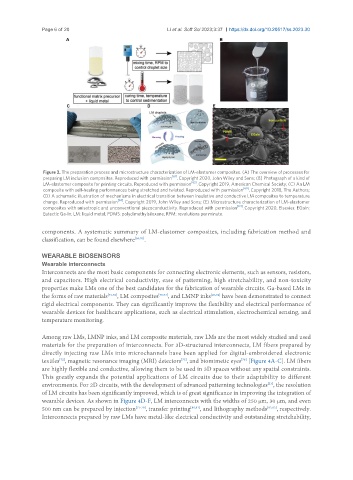
                Figure 3. The preparation process and microstructure characterization of LM-elastomer composites. (A) The overview of processes for
                                                           [61]
                preparing LM inclusion composites. Reproduced with permission  . Copyright 2020, John Wiley and Sons; (B) Photograph of a kind of
                                                                 [62]
                LM-elastomer composite for printing circuits. Reproduced with permission  . Copyright 2019, American Chemical Society; (C) An LM
                                                                                   [60]
                composite with self-healing performances being stretched and twisted. Reproduced with permission  . Copyright 2018, The Authors;
                (D) A schematic illustration of mechanisms in electrical transition between insulative and conductive LM composites to temperature
                                         [63]
                change. Reproduced with  permission  . Copyright 2019, John Wiley and Sons; (E) Microstructure characterization of LM-elastomer
                composites with anisotropic and unconventional piezoconductivity. Reproduced with permission [64] . Copyright 2020, Elsevier. EGaIn:
                Eutectic Ga-In; LM: liquid metal; PDMS: polydimethylsiloxane; RPM: revolutions per minute.
               components. A systematic summary of LM-elastomer composites, including fabrication method and
               classification, can be found elsewhere [69,70] .

               WEARABLE BIOSENSORS
               Wearable interconnects
               Interconnects are the most basic components for connecting electronic elements, such as sensors, resistors,
               and capacitors. High electrical conductivity, ease of patterning, high stretchability, and non-toxicity
               properties make LMs one of the best candidates for the fabrication of wearable circuits. Ga-based LMs in
               the forms of raw materials [71,72] , LM composites [70,73] , and LMNP inks [20,74]  have been demonstrated to connect
               rigid electrical components. They can significantly improve the flexibility and electrical performance of
               wearable devices for healthcare applications, such as electrical stimulation, electrochemical sensing, and
               temperature monitoring.


               Among raw LMs, LMNP inks, and LM composite materials, raw LMs are the most widely studied and used
               materials for the preparation of interconnects. For 3D-structured interconnects, LM fibers prepared by
               directly injecting raw LMs into microchannels have been applied for digital-embroidered electronic
                     [72]
               textiles , magnetic resonance imaging (MRI) detectors , and biomimetic eyes  [Figure 4A-C]. LM fibers
                                                              [75]
                                                                                  [76]
               are highly flexible and conductive, allowing them to be used in 3D spaces without any spatial constraints.
               This greatly expands the potential applications of LM circuits due to their adaptability to different
               environments. For 2D circuits, with the development of advanced patterning technologies , the resolution
                                                                                           [23]
               of LM circuits has been significantly improved, which is of great significance in improving the integration of
               wearable devices. As shown in Figure 4D-F, LM interconnects with the widths of 250 μm, 30 μm, and even
               500 nm can be prepared by injection [77-79] , transfer printing [80,81] , and lithography methods [82,83] , respectively.
               Interconnects prepared by raw LMs have metal-like electrical conductivity and outstanding stretchability,

