


Page 23 - Read Online
P. 23
Li et al. Soft Sci 2023;3:37  https://dx.doi.org/10.20517/ss.2023.30             Page 9 of 20


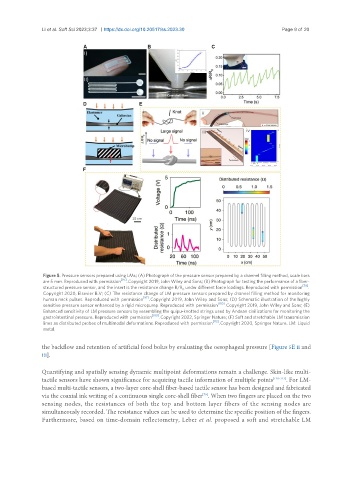
                Figure 5. Pressure sensors prepared using LMs; (A) Photograph of the pressure sensor prepared by a channel filling method, scale bars
                                          [97]
                are 5 mm. Reproduced with permission  . Copyright 2019, John Wiley and Sons; (B) Photograph for testing the performance of a fiber-
                                                                                                       [79]
                structured pressure sensor, and the insert is the resistance change R/R  under different force loadings. Reproduced with permission  .
                                                               0
                Copyright 2020, Elsevier B.V; (C) The resistance change of LM pressure sensors prepared by channel filling method for monitoring
                                                 [97]
                human neck pulses. Reproduced with  permission  . Copyright 2019, John Wiley and Sons; (D) Schematic illustration of the highly
                                                                          [103]
                sensitive pressure sensor enhanced by a rigid micropump. Reproduced with permission  . Copyright 2019, John Wiley and Sons; (E)
                Enhanced sensitivity of LM pressure sensors by resembling the quipu-knotted strings used by Andean civilizations for monitoring the
                                                    [109]
                gastrointestinal pressure. Reproduced with permission  . Copyright 2022, Springer Nature; (F) Soft and stretchable LM transmission
                lines as distributed probes of multimodal deformations. Reproduced with permission [113] . Copyright 2020, Springer Nature. LM: Liquid
                metal.
               the backflow and retention of artificial food bolus by evaluating the oesophageal pressure [Figure 5E ii and
               iii].
               Quantifying and spatially sensing dynamic multipoint deformations remain a challenge. Skin-like multi-
               tactile sensors have shown significance for acquiring tactile information of multiple points [110-112] . For LM-
               based multi-tactile sensors, a two-layer core-shell fiber-based tactile sensor has been designed and fabricated
                                                                     [79]
               via the coaxial ink writing of a continuous single core-shell fiber . When two fingers are placed on the two
               sensing nodes, the resistances of both the top and bottom layer fibers of the sensing nodes are
               simultaneously recorded. The resistance values can be used to determine the specific position of the fingers.
               Furthermore, based on time-domain reflectometry, Leber et al. proposed a soft and stretchable LM

