


Page 27 - Read Online
P. 27
Li et al. Soft Sci 2023;3:37  https://dx.doi.org/10.20517/ss.2023.30            Page 13 of 20


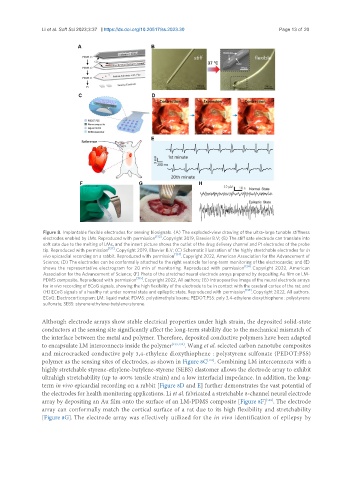
                Figure 8. Implantable flexible electrodes for sensing biosignals. (A) The exploded-view drawing of the ultra-large tunable stiffness
                electrodes enabled by LMs. Reproduced with permission [132] . Copyright 2019, Elsevier B.V; (B) The stiff sate electrode can translate into
                soft sate due to the melting of LMs, and the insert picture shows the outlet of the drug delivery channel and Pt electrodes of the probe
                tip. Reproduced with permission [132] . Copyright 2019, Elsevier B.V; (C) Schematic illustration of the highly stretchable electrodes for in
                vivo epicardial recording on a rabbit. Reproduced with permission [134] . Copyright 2022, American Association for the Advancement of
                Science; (D) The electrodes can be conformally attached to the right ventricle for long-term monitoring of the electrocardio; and (E)
                shows the representative electrogram for 20 min of monitoring. Reproduced with  permission [134] . Copyright 2022, American
                Association for the Advancement of Science; (F) Photo of the stretched neural electrode arrays prepared by depositing Au film on LM-
                PDMS composite. Reproduced with permission [135] . Copyright 2022, All authors; (G) Intraoperative image of the neural electrode arrays
                for in vivo recording of ECoG signals, showing the high flexibility of the electrode to be in contact with the cerebral cortex of the rat; and
                (H) ECoG signals of a healthy rat under normal state and epileptic state. Reproduced with permission [135] . Copyright 2022, All authors.
                ECoG: Electrocorticogram; LM: liquid metal; PDMS: polydimethylsiloxane; PEDOT:PSS: poly 3,4-ethylene dioxythiophene : polystyrene
                sulfonate; SEBS: styrene-ethylene-butylene-styrene.

               Although electrode arrays show stable electrical properties under high strain, the deposited solid-state
               conductors at the sensing site significantly affect the long-term stability due to the mechanical mismatch of
               the interface between the metal and polymer. Therefore, deposited conductive polymers have been adapted
               to encapsulate LM interconnects inside the polymer [133,134] . Wang et al. selected carbon nanotube composites
               and microcracked conductive poly 3,4-ethylene dioxythiophene : polystyrene sulfonate (PEDOT:PSS)
               polymer as the sensing sites of electrodes, as shown in Figure 8C . Combining LM interconnects with a
                                                                       [134]
               highly stretchable styrene-ethylene-butylene-styrene (SEBS) elastomer allows the electrode array to exhibit
               ultrahigh stretchability (up to 400% tensile strain) and a low interfacial impedance. In addition, the long-
               term in vivo epicardial recording on a rabbit [Figure 8D and E] further demonstrates the vast potential of
               the electrodes for health monitoring applications. Li et al. fabricated a stretchable 8-channel neural electrode
               array by depositing an Au film onto the surface of an LM-PDMS composite [Figure 8F] . The electrode
                                                                                           [135]
               array can conformally match the cortical surface of a rat due to its high flexibility and stretchability
               [Figure 8G]. The electrode array was effectively utilized for the in vivo identification of epilepsy by

