


Page 29 - Read Online
P. 29
Li et al. Soft Sci 2023;3:37  https://dx.doi.org/10.20517/ss.2023.30            Page 15 of 20


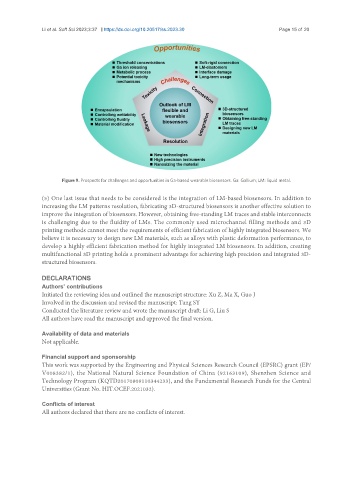
                      Figure 9. Prospects for challenges and opportunities in Ga-based wearable biosensors. Ga: Gallium; LM: liquid metal.

               (5) One last issue that needs to be considered is the integration of LM-based biosensors. In addition to
               increasing the LM patterns resolution, fabricating 3D-structured biosensors is another effective solution to
               improve the integration of biosensors. However, obtaining free-standing LM traces and stable interconnects
               is challenging due to the fluidity of LMs. The commonly used microchannel filling methods and 3D
               printing methods cannot meet the requirements of efficient fabrication of highly integrated biosensors. We
               believe it is necessary to design new LM materials, such as alloys with plastic deformation performance, to
               develop a highly efficient fabrication method for highly integrated LM biosensors. In addition, creating
               multifunctional 3D printing holds a prominent advantage for achieving high precision and integrated 3D-
               structured biosensors.


               DECLARATIONS
               Authors’ contributions
               Initiated the reviewing idea and outlined the manuscript structure: Xu Z, Ma X, Guo J
               Involved in the discussion and revised the manuscript: Tang SY
               Conducted the literature review and wrote the manuscript draft: Li G, Liu S
               All authors have read the manuscript and approved the final version.


               Availability of data and materials
               Not applicable.


               Financial support and sponsorship
               This work was supported by the Engineering and Physical Sciences Research Council (EPSRC) grant (EP/
               V008382/1), the National Natural Science Foundation of China (92163109), Shenzhen Science and
               Technology Program (KQTD20170809110344233), and the Fundamental Research Funds for the Central
               Universities (Grant No. HIT.OCEF.2021032).

               Conflicts of interest
               All authors declared that there are no conflicts of interest.

