


Page 25 - Read Online
P. 25
Li et al. Soft Sci 2023;3:37  https://dx.doi.org/10.20517/ss.2023.30            Page 11 of 20


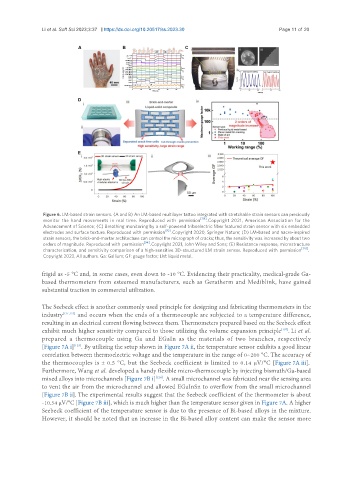
                Figure 6. LM-based strain sensors. (A and B) An LM-based multilayer tattoo integrated with stretchable strain sensors can preciously
                monitor  the  hand  movements  in  real  time.  Reproduced  with  permission [118] . Copyright  2021,  American  Association  for  the
                Advancement of Science; (C) Breathing monitoring by a self-powered triboelectric fiber featured strain sensor with six embedded
                electrodes and surface texture. Reproduced with  permission [92] . Copyright 2020, Springer Nature; (D) LM-based and nacre-inspired
                strain sensors, the brick-and-mortar architecture can control the micrograph of cracks; thus, the sensitivity was increased by about two
                orders of magnitude. Reproduced with permission [94] . Copyright 2021, John Wiley and Sons; (E) Resistance response, microstructure
                characterization, and sensitivity comparison of a high-sensitive 3D-structured LM strain sensor. Reproduced with  permission [120] .
                Copyright 2023, All authors. Ga: Gallium; GF: gauge factor; LM: liquid metal.

               frigid as -5 °C and, in some cases, even down to -10 °C. Evidencing their practicality, medical-grade Ga-
               based thermometers from esteemed manufacturers, such as Geratherm and Mediblink, have gained
               substantial traction in commercial utilization.


               The Seebeck effect is another commonly used principle for designing and fabricating thermometers in the
               industry [121,122]  and occurs when the ends of a thermocouple are subjected to a temperature difference,
               resulting in an electrical current flowing between them. Thermometers prepared based on the Seebeck effect
               exhibit much higher sensitivity compared to those utilizing the volume expansion principle . Li et al.
                                                                                                [107]
               prepared  a  thermocouple  using  Ga  and  EGaIn  as  the  materials  of  two  branches,  respectively
               [Figure 7A i] . By utilizing the setup shown in Figure 7A ii, the temperature sensor exhibits a good linear
                          [123]
               correlation between thermoelectric voltage and the temperature in the range of 0~200 °C. The accuracy of
               the thermocouples is  ± 0.5 °C, but the Seebeck coefficient is limited to 0.14  μV/°C [Figure 7A iii].
               Furthermore, Wang et al. developed a handy flexible micro-thermocouple by injecting bismuth/Ga-based
               mixed alloys into microchannels [Figure 7B i] . A small microchannel was fabricated near the sensing area
                                                     [124]
               to vent the air from the microchannel and allowed EGaInSn to overflow from the small microchannel
               [Figure 7B ii]. The experimental results suggest that the Seebeck coefficient of the thermometer is about
               -10.54 μV/°C [Figure 7B iii], which is much higher than the temperature sensor given in Figure 7A. A higher
               Seebeck coefficient of the temperature sensor is due to the presence of Bi-based alloys in the mixture.
               However, it should be noted that an increase in the Bi-based alloy content can make the sensor more

