


Page 90 - Read Online
P. 90
Page 10 of 20                             Lu et al. Soft Sci 2024;4:36  https://dx.doi.org/10.20517/ss.2024.29

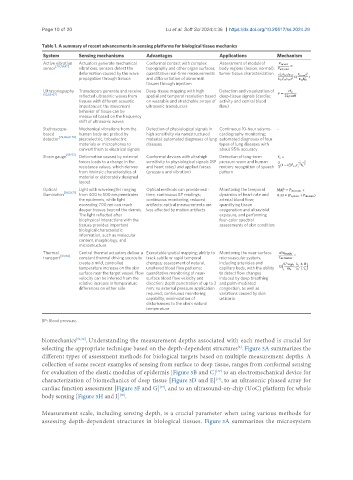
               Table 1. A summary of recent advancements in sensing platforms for biological tissue mechanics
                System      Sensing mechanisms    Advantages               Applications       Mechanism
                Active vibration  Actuators generate mechanical   Conformal contact with complex   Assessment of moduli of
                    [28,29,42]
                sensor      vibrations; sensors detect the   topography and other organ surfaces;  body regions (lesion, normal);
                            deformation caused by the wave   quantitative real-time measurements  tumor tissue characterization
                            propagation through tissues  and differentiation of abnormal
                                                  tissues through injection
                Ultrasonography  Transducers generate and receive  Deep-tissue mapping with high   Detection and visualization of
                [52,65-67]
                            reflected ultrasonic waves from   spatial and temporal resolution based  deep-tissue signals (cardiac
                            tissues with different acoustic   on wearable and stretchable arrays of  activity and central blood
                            impedances; the movement   ultrasonic transducers  flow)
                            behavior of tissue can be
                            measured based on the frequency
                            shift of ultrasonic waves
                Stethoscope-  Mechanical vibrations from the   Detection of physiological signals in   Continuous 10-hour seismo-  -
                based       human body are probed by   high sensitivity via nanostructured   cardiography monitoring;
                     [29,41,68-70]
                detector    piezoelectric, triboelectric   material; automated diagnoses of lung  automated diagnoses of four
                            materials or microphones to   diseases         types of lung diseases with
                            convert them to electrical signals             about 95% accuracy
                       [55-57]
                Strain gauge  Deformation caused by external   Conformal devices with ultrahigh   Detection of long-term
                            forces leads to a change in the   sensitivity to physiological signals (BP  pressure wave and human
                            resistance values, which derives   and heart rates) and applied forces   motion; recognition of speech
                            from intrinsic characteristics of   (pressure and vibration)  pattern
                            material or elaborately designed
                            layout
                Optical     Light with wavelengths ranging   Optical methods can provide real-  Monitoring the temporal
                illumination [58,59,71]  from 400 to 500 nm penetrates   time, continuous BP readings;   dynamics of heart rate and
                            the epidermis, while light   continuous monitoring; reduced   arterial blood flow;
                            exceeding 700 nm can reach   artifacts: optical measurements are   quantifying tissue
                            deeper tissues beyond the dermis.  less affected by motion artifacts  oxygenation and ultraviolet
                            The light reflected after                      exposure; and performing
                            biophysical interactions with the              four-color spectral
                            tissues provides important                     assessments of skin condition
                            biological characteristic
                            information, such as molecular
                            content, morphology, and
                            microstructure
                Thermal     Central thermal actuators deliver a  Executable spatial mapping; ability to  Monitoring the near-surface
                     [63,64]
                transport   constant thermal driving source to  track subtle or rapid temporal   microvascular system,
                            create a mild, controlled   changes; assessment of natural,   including arterioles and
                            temperature increase on the skin   unaltered blood flow patterns;   capillary beds, with the ability
                            surface near the target vessel. Flow  quantitative monitoring of near-  to detect flow changes
                            velocity can be inferred from the   surface blood flow velocity and   induced by deep breathing
                            relative increase in temperature   direction; depth penetration of up to 2  and palm-mediated
                            differences on either side  mm; no external pressure application  congestion, as well as
                                                  required; continuous monitoring   variations caused by skin
                                                  capability; minimization of   urticaria
                                                  disturbances to the skin’s natural
                                                  temperature
               BP: Blood pressure.


               biomechanics [71,72] . Understanding the measurement depths associated with each method is crucial for
                                                                                 [2]
               selecting the appropriate technique based on the depth-dependent structures . Figure 3A summarizes the
               different types of assessment methods for biological targets based on multiple measurement depths. A
               collection of some recent examples of sensing from surface to deep tissue, ranges from conformal sensing
               for evaluation of the elastic modulus of epidermis [Figure 3B and C]  to an electromechanical device for
                                                                          [29]
                                                                          [73]
               characterization of biomechanics of deep tissue [Figure 3D and E] , to an ultrasonic phased array for
                                                       [74]
               cardiac function assessment [Figure 3F and G] , and to an ultrasound-on-chip (UoC) platform for whole
               body sensing [Figure 3H and I] .
                                         [65]
               Measurement scale, including sensing depth, is a crucial parameter when using various methods for
               assessing depth-dependent structures in biological tissues. Figure 3A summarizes the microsystem

