


Page 89 - Read Online
P. 89
Lu et al. Soft Sci 2024;4:36  https://dx.doi.org/10.20517/ss.2024.29             Page 9 of 20

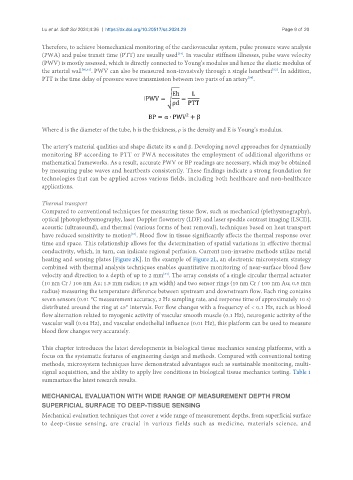
               Therefore, to achieve biomechanical monitoring of the cardiovascular system, pulse pressure wave analysis
                                                             [34]
               (PWA) and pulse transit time (PTT) are usually used . In vascular stiffness illnesses, pulse wave velocity
               (PWV) is mostly assessed, which is directly connected to Young’s modulus and hence the elastic modulus of
                                                                                             [62]
               the arterial wall [60,61] . PWV can also be measured non-invasively through a single heartbeat . In addition,
               PTT is the time delay of pressure wave transmission between two parts of an artery .
                                                                                     [34]


               Where d is the diameter of the tube, h is the thickness, ρ is the density and E is Young’s modulus.


               The artery’s material qualities and shape dictate its α and β. Developing novel approaches for dynamically
               monitoring BP according to PTT or PWA necessitates the employment of additional algorithms or
               mathematical frameworks. As a result, accurate PWV or BP readings are necessary, which may be obtained
               by measuring pulse waves and heartbeats consistently. These findings indicate a strong foundation for
               technologies that can be applied across various fields, including both healthcare and non-healthcare
               applications.


               Thermal transport
               Compared to conventional techniques for measuring tissue flow, such as mechanical (plethysmography),
               optical [photoplethysmography, laser Doppler flowmetry (LDF) and laser speckle contrast imaging (LSCI)],
               acoustic (ultrasound), and thermal (various forms of heat removal), techniques based on heat transport
               have reduced sensitivity to motion . Blood flow in tissue significantly affects the thermal response over
                                             [63]
               time and space. This relationship allows for the determination of spatial variations in effective thermal
               conductivity, which, in turn, can indicate regional perfusion. Current non-invasive methods utilize metal
               heating and sensing plates [Figure 2K]. In the example of Figure 2L, an electronic microsystem strategy
               combined with thermal analysis techniques enables quantitative monitoring of near-surface blood flow
               velocity and direction to a depth of up to 2 mm . The array consists of a single circular thermal actuator
                                                        [64]
               (10 nm Cr / 100 nm Au; 1.5 mm radius; 15 μm width) and two sensor rings (10 nm Cr / 100 nm Au; 0.5 mm
               radius) measuring the temperature difference between upstream and downstream flow. Each ring contains
               seven sensors (0.01 °C measurement accuracy, 2 Hz sampling rate, and response time of approximately 10 s)
               distributed around the ring at 45° intervals. For flow changes with a frequency of < 0.1 Hz, such as blood
               flow alternation related to myogenic activity of vascular smooth muscle (0.1 Hz), neurogenic activity of the
               vascular wall (0.04 Hz), and vascular endothelial influence (0.01 Hz), this platform can be used to measure
               blood flow changes very accurately.

               This chapter introduces the latest developments in biological tissue mechanics sensing platforms, with a
               focus on the systematic features of engineering design and methods. Compared with conventional testing
               methods, microsystem techniques have demonstrated advantages such as sustainable monitoring, multi-
               signal acquisition, and the ability to apply live conditions in biological tissue mechanics testing. Table 1
               summarizes the latest research results.


               MECHANICAL EVALUATION WITH WIDE RANGE OF MEASUREMENT DEPTH FROM
               SUPERFICIAL SURFACE TO DEEP-TISSUE SENSING
               Mechanical evaluation techniques that cover a wide range of measurement depths, from superficial surface
               to  deep-tissue  sensing,  are  crucial  in  various  fields  such  as  medicine,  materials  science,  and

