


Page 85 - Read Online
P. 85
Lu et al. Soft Sci 2024;4:36  https://dx.doi.org/10.20517/ss.2024.29             Page 5 of 20

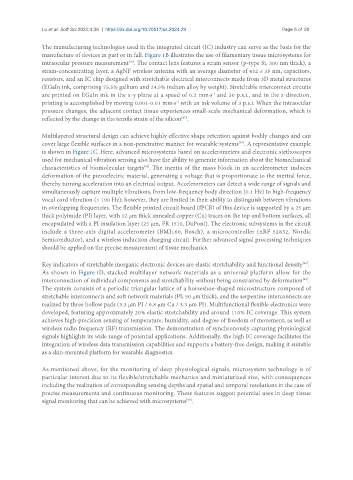
               The manufacturing technologies used in the integrated circuit (IC) industry can serve as the basis for the
               manufacture of devices in part or in full. Figure 1B illustrates the use of filamentary tissue microsystems for
                                            [10]
               intraocular pressure measurement . The contact lens features a strain sensor (p-type Si, 300 nm thick), a
               strain-concentrating layer, a AgNF wireless antenna with an average diameter of 432 ± 35 nm, capacitors,
               resistors, and an IC chip designed with stretchable electrical interconnects made from 3D metal structures
               (EGaIn ink, comprising 75.5% gallium and 24.5% indium alloy by weight). Stretchable interconnect circuits
               are printed on EGaIn ink in the x-y plane at a speed of 0.2 mm·s  and 30 p.s.i., and in the z-direction,
                                                                         -1
                                                            -1
               printing is accomplished by moving 0.001-0.01 mm·s  with an ink volume of 3 p.s.i. When the intraocular
               pressure changes, the adjacent contact tissue experiences small-scale mechanical deformation, which is
                                                              [47]
               reflected by the change in the tensile strain of the silicon .

               Multilayered structural design can achieve highly effective shape retention against bodily changes and can
               cover large flexible surfaces in a non-penetrative manner for wearable systems . A representative example
                                                                                 [48]
               is shown in Figure 1C. Here, advanced microsystems based on accelerometers and electronic stethoscopes
               used for mechanical vibration sensing also have the ability to generate information about the biomechanical
                                                  [45]
               characteristics of biomolecular targets . The inertia of the mass block in an accelerometer induces
               deformation of the piezoelectric material, generating a voltage that is proportionate to the inertial force,
               thereby turning acceleration into an electrical output. Accelerometers can detect a wide range of signals and
               simultaneously capture multiple vibrations, from low-frequency body direction (0.1 Hz) to high-frequency
               vocal cord vibration (> 100 Hz); however, they are limited in their ability to distinguish between vibrations
               in overlapping frequencies. The flexible printed circuit board (fPCB) of this device is supported by a 25 μm
               thick polyimide (PI) layer, with 12 μm thick annealed copper (Cu) traces on the top and bottom surfaces, all
               encapsulated with a PI insulation layer (25 μm, FR 1510, DuPont). The electronic subsystems in the circuit
               include a three-axis digital accelerometer (BMI160, Bosch), a microcontroller (nRF 52832, Nordic
               Semiconductor), and a wireless induction charging circuit. Further advanced signal processing techniques
               should be applied on the precise measurement of tissue mechanics.


               Key indicators of stretchable inorganic electronic devices are elastic stretchability and functional density .
                                                                                                       [49]
               As shown in Figure 1D, stacked multilayer network materials as a universal platform allow for the
                                                                                                       [46]
               interconnection of individual components and stretchability without being constrained by deformation .
               The system consists of a periodic triangular lattice of a horseshoe-shaped microstructure composed of
               stretchable interconnects and soft network materials (PI; 50 μm thick), and the serpentine interconnects are
               realized by three hollow pads (3.3 μm PI / 0.8 μm Cu / 3.3 μm PI). Multifunctional flexible electronics were
               developed, featuring approximately 20% elastic stretchability and around 110% IC coverage. This system
               achieves high-precision sensing of temperature, humidity, and degree of freedom of movement, as well as
               wireless radio frequency (RF) transmission. The demonstration of synchronously capturing physiological
               signals highlights its wide range of potential applications. Additionally, the high IC coverage facilitates the
               integration of wireless data transmission capabilities and supports a battery-free design, making it suitable
               as a skin-mounted platform for wearable diagnostics.


               As mentioned above, for the monitoring of deep physiological signals, microsystem technology is of
               particular interest due to its flexible/stretchable mechanics and miniaturized size, with consequences
               including the realization of corresponding sensing depths and spatial and temporal resolutions in the case of
               precise measurements and continuous monitoring. These features suggest potential uses in deep tissue
               signal monitoring that can be achieved with microsystems .
                                                                [50]

