


Page 88 - Read Online
P. 88
Page 8 of 20                              Lu et al. Soft Sci 2024;4:36  https://dx.doi.org/10.20517/ss.2024.29

               into electrical signals using piezoelectric or triboelectric materials. Wearable stethoscopes can incorporate
                                                                                    [54]
               nanostructured materials, such as a nanofiber electronic stethoscope [Figure 2F] . This sensor features a
               layer of polyvinylidene fluoride nanofibers situated between two nanofiber electrodes, with a gap (thickness
               of 5-15 µm) between the bipolar electrodes. The multilayered nanofiber sensor structure generates large
               vibration under the action of sound waves, making an acoustic sensitivity of up to 1 as high as
                            -1
               10,050.6 mV·Pa  in the frequency range of 10 to 500 Hz, which allows for continuous measurement of
               mechanoacoustic cardiac signals for longer periods of time (> 10 h) with an ultra-high signal-to-noise ratio
               of 40.9 dB.

               Strain gauge
               The self-locking stretchable strain sensor provides a fingertip measurement platform for the rapid detection
               of Young’s modulus of soft materials (kPa-MPa) [Figure 2G]. The platform introduces the self-locking
               effect in the Hertz model to design a single stretchable strain sensor to achieve fingertip touch, avoiding the
               bulky displacement feedback systems typically required in conventional methods [Figure 2H] . The
                                                                                                    [55]
               platform can measure the sample with just a simple contact, without considering the measurement process,
               which means that the fingertip modulus sensor (FMS) can quickly measure Young’s modulus anytime and
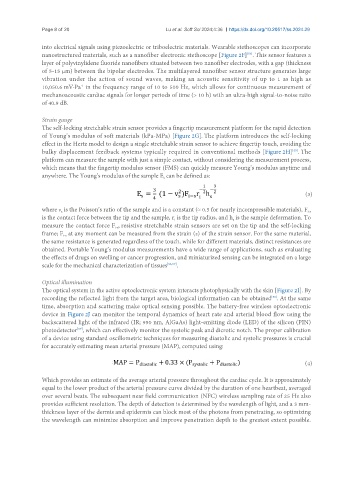
               anywhere. The Young’s modulus of the sample E  can be defined as:
                                                        s

                                                                                                        (3)

               where ν  is the Poisson’s ratio of the sample and is a constant (≈ 0.5 for nearly incompressible materials), F
                                                                                                         i-s
                      s
               is the contact force between the tip and the sample, r is the tip radius, and h  is the sample deformation. To
                                                                                s
                                                            i
               measure the contact force F , resistive stretchable strain sensors are set on the tip and the self-locking
                                        i-s
               frame; F  at any moment can be measured from the strain (ε) of the strain sensor. For the same material,
                      i-s
               the same resistance is generated regardless of the touch, while for different materials, distinct resistances are
               obtained. Portable Young’s modulus measurements have a wide range of applications, such as evaluating
               the effects of drugs on swelling or cancer progression, and miniaturized sensing can be integrated on a large
               scale for the mechanical characterization of tissues [56,57] .

               Optical illumination
               The optical system in the active optoelectronic system interacts photophysically with the skin [Figure 2I]. By
                                                                                             [58]
               recording the reflected light from the target area, biological information can be obtained . At the same
               time, absorption and scattering make optical sensing possible. The battery-free wireless optoelectronic
               device in Figure 2J can monitor the temporal dynamics of heart rate and arterial blood flow using the
               backscattered light of the infrared (IR; 950 nm, AlGaAs) light-emitting diode (LED) of the silicon (PIN)
               photodetector , which can effectively monitor the systolic peak and dicrotic notch. The proper calibration
                           [59]
               of a device using standard oscillometric techniques for measuring diastolic and systolic pressures is crucial
               for accurately estimating mean arterial pressure (MAP), computed using:


                                                                                                        (4)

               Which provides an estimate of the average arterial pressure throughout the cardiac cycle. It is approximately
               equal to the lower product of the arterial pressure curve divided by the duration of one heartbeat, averaged
               over several beats. The subsequent near field communication (NFC) wireless sampling rate of 25 Hz also
               provides sufficient resolution. The depth of detection is determined by the wavelength of light, and a 3 mm-
               thickness layer of the dermis and epidermis can block most of the photons from penetrating, so optimizing
               the wavelength can minimize absorption and improve penetration depth to the greatest extent possible.

