


Page 86 - Read Online
P. 86
Page 6 of 20                              Lu et al. Soft Sci 2024;4:36  https://dx.doi.org/10.20517/ss.2024.29

               Measurement mechanisms and engineered designs
               Active vibration sensor
               Passive or active mechanical sensing can effectively capture deep tissue movements. The principle of active
               mechanical sensing involves applying external loads to study their mechanical responses . The modulus of
                                                                                          [51]
               adjacent contacting tissues can be determined by analyzing data obtained after applying voltage to the
               mechanical actuator and measuring the induced voltage at the sensor [Figure 2A]. In the example of
               Figure 2B, microelements (dimensions 200 μm × 140 μm, spaced 1 mm apart) composed of piezoelectric
               material lead zirconate titanate (PZT) provide both mechanical actuation (far from the tip) and sensing
               (near the tip) . Active elements consist of patterned multilayer stacks of PZT (500 nm) between bottom
                           [28]
               (Ti/Pt, 5/200 nm) and top (Cr/Au, 10/200 nm) electrodes. Piezoelectric microsystems provide a
               foundational design tool for rapid modulus-based characterization of tissues [29,42] . The dependence of the
               sensor voltage on tissue modulus is non-monotonic. In the low modulus state, the free deformation of the
               actuator and substrate makes their response highly localized, which results in a small strain generated in the
               sensor and a correspondingly small voltage output. In the high modulus state, the mechanical load limits the
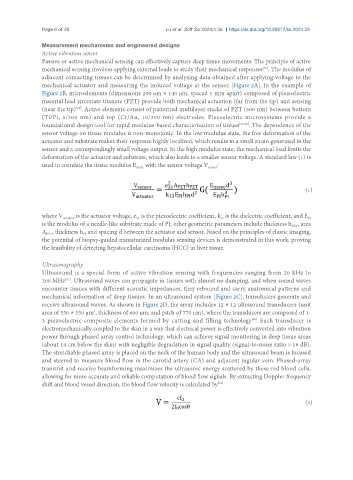
               deformation of the actuator and substrate, which also leads to a smaller sensor voltage. A standard law (1) is
               used to correlate the tissue modulus E tissue  with the sensor voltage V sensor :


                                                                                                        (1)


               where V actuator  is the actuator voltage, e  is the piezoelectric coefficient, k  is the dielectric coefficient, and E
                                                                                                         PI
                                                                           33
                                               31
               is the modulus of a needle-like substrate made of PI; other geometric parameters include thickness h , area
                                                                                                   PZT
               A , thickness h  and spacing d between the actuator and sensor. Based on the principles of elastic imaging,
                             PI
                 PZT
               the potential of biopsy-guided miniaturized modulus sensing devices is demonstrated in this work, proving
               the feasibility of detecting hepatocellular carcinoma (HCC) in liver tissue.
               Ultrasonography
               Ultrasound is a special form of active vibration sensing with frequencies ranging from 20 kHz to
               200 MHz . Ultrasound waves can propagate in tissues with almost no damping, and when sound waves
                       [51]
               encounter tissues with different acoustic impedances, they rebound and carry anatomical patterns and
               mechanical information of deep tissues. In an ultrasound system [Figure 2C], transducers generate and
               receive ultrasound waves. As shown in Figure 2D, the array includes 12 × 12 ultrasound transducers (unit
                                 2
               area of 550 × 550 µm , thickness of 600 µm, and pitch of 770 µm), where the transducers are composed of 1-
               3 piezoelectric composite elements formed by cutting and filling technology . Each transducer is
                                                                                      [52]
               electromechanically coupled to the skin in a way that electrical power is effectively converted into vibration
               power through phased array control technology, which can achieve signal monitoring in deep tissue areas
               (about 14 cm below the skin) with negligible degradation in signal quality (signal-to-noise ratio > 18 dB).
               The stretchable phased array is placed on the neck of the human body and the ultrasound beam is focused
               and steered to measure blood flow in the carotid artery (CA) and adjacent jugular vein. Phased-array
               transmit and receive beamforming maximizes the ultrasonic energy scattered by these red blood cells,
               allowing for more accurate and reliable computation of blood flow signals. By extracting Doppler frequency
               shift and blood vessel direction, the blood flow velocity is calculated by [53]


                                                                                                        (2)

