


Page 31 - Read Online
P. 31
Page 8 of 34                              Ma et al. Soft Sci 2024;4:26  https://dx.doi.org/10.20517/ss.2024.20


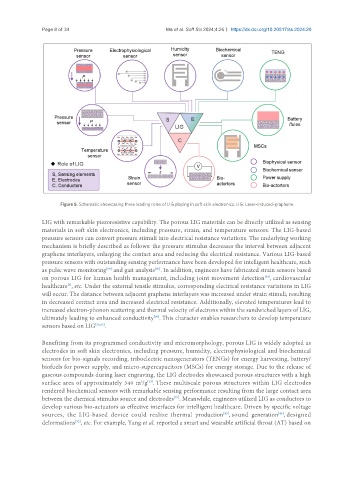
                     Figure 5. Schematic showcasing three leading roles of LIG playing in soft skin electronics. LIG: Laser-induced-graphene.

               LIG with remarkable piezoresistive capability. The porous LIG materials can be directly utilized as sensing
               materials in soft skin electronics, including pressure, strain, and temperature sensors. The LIG-based
               pressure sensors can convert pressure stimuli into electrical resistance variations. The underlying working
               mechanism is briefly described as follows: the pressure stimulus decreases the interval between adjacent
               graphene interlayers, enlarging the contact area and reducing the electrical resistance. Various LIG-based
               pressure sensors with outstanding sensing performance have been developed for intelligent healthcare, such
                                     [60]
                                                     [60]
               as pulse wave monitoring  and gait analysis . In addition, engineers have fabricated strain sensors based
               on porous LIG for human health management, including joint movement detection , cardiovascular
                                                                                          [89]
               healthcare , etc. Under the external tensile stimulus, corresponding electrical resistance variations in LIG
                        [3]
               will occur. The distance between adjacent graphene interlayers was increased under strain stimuli, resulting
               in decreased contact area and increased electrical resistance. Additionally, elevated temperatures lead to
               increased electron-phonon scattering and thermal velocity of electrons within the sandwiched layers of LIG,
                                                     [90]
               ultimately leading to enhanced conductivity . This character enables researchers to develop temperature
               sensors based on LIG [35,91] .

               Benefiting from its programmed conductivity and micromorphology, porous LIG is widely adopted as
               electrodes in soft skin electronics, including pressure, humidity, electrophysiological and biochemical
               sensors for bio-signals recording, triboelectric nanogenerators (TENGs) for energy harvesting, battery/
               biofuels for power supply, and micro-supercapacitors (MSCs) for energy storage. Due to the release of
               gaseous compounds during laser engraving, the LIG electrodes showcased porous structures with a high
                                                 2
                                                   [23]
               surface area of approximately 340 m /g . These multiscale porous structures within LIG electrodes
               rendered biochemical sensors with remarkable sensing performance resulting from the large contact area
               between the chemical stimulus source and electrodes . Meanwhile, engineers utilized LIG as conductors to
                                                            [75]
               develop various bio-actuators as effective interfaces for intelligent healthcare. Driven by specific voltage
               sources,  the  LIG-based  device  could  realize  thermal  production , sound  generation , designed
                                                                            [45]
                                                                                               [46]
                          [32]
               deformations , etc. For example, Yang et al. reported a smart and wearable artificial throat (AT) based on

