


Page 30 - Read Online
P. 30
Ma et al. Soft Sci 2024;4:26  https://dx.doi.org/10.20517/ss.2024.20              Page 7 of 34


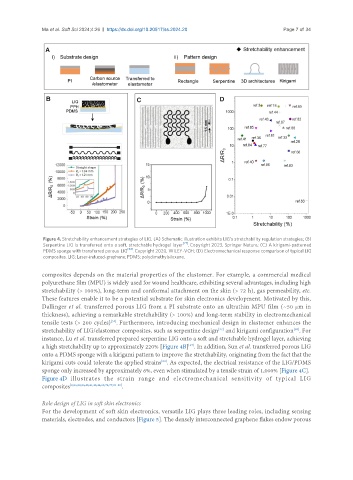
                Figure 4. Stretchability enhancement strategies of LIG. (A) Schematic illustration exhibits LIG’s stretchability regulation strategies; (B)
                Serpentine LIG is transferred onto a soft, stretchable hydrogel  layer [27] . Copyright 2023, Springer Nature; (C) A kirigami-patterned
                PDMS sponge with transferred porous LIG [83] . Copyright 2020, WILEY-VCH; (D) Electromechanical response comparison of typical LIG
                composites. LIG: Laser-induced-graphene; PDMS: polydimethylsiloxane.

               composites depends on the material properties of the elastomer. For example, a commercial medical
               polyurethane film (MPU) is widely used for wound healthcare, exhibiting several advantages, including high
               stretchability (> 100%), long-term and conformal attachment on the skin (> 72 h), gas permeability, etc.
               These features enable it to be a potential substrate for skin electronics development. Motivated by this,
               Dallinger et al. transferred porous LIG from a PI substrate onto an ultrathin MPU film (~50 μm in
               thickness), achieving a remarkable stretchability (> 100%) and long-term stability in electromechanical
               tensile tests (> 200 cycles) . Furthermore, introducing mechanical design in elastomer enhances the
                                      [34]
                                                                           [27]
               stretchability of LIG/elastomer composites, such as serpentine design  and kirigami configuration . For
                                                                                                    [83]
               instance, Lu et al. transferred prepared serpentine LIG onto a soft and stretchable hydrogel layer, achieving
                                                                 [27]
               a high stretchability up to approximately 220% [Figure 4B] . In addition, Sun et al. transferred porous LIG
               onto a PDMS sponge with a kirigami pattern to improve the stretchability, originating from the fact that the
                                                       [83]
               kirigami cuts could tolerate the applied strains . As expected, the electrical resistance of the LIG/PDMS
               sponge only increased by approximately 6%, even when stimulated by a tensile strain of 1,000% [Figure 4C].
               Figure 4D  illustrates  the  strain  range  and  electromechanical  sensitivity  of  typical  LIG
               composites [3,26,33,36,40,41,43,44,68,74,77,81-89] .


               Role design of LIG in soft skin electronics
               For the development of soft skin electronics, versatile LIG plays three leading roles, including sensing
               materials, electrodes, and conductors [Figure 5]. The densely interconnected graphene flakes endow porous

