


Page 26 - Read Online
P. 26
Ma et al. Soft Sci 2024;4:26  https://dx.doi.org/10.20517/ss.2024.20              Page 3 of 34


                                        2
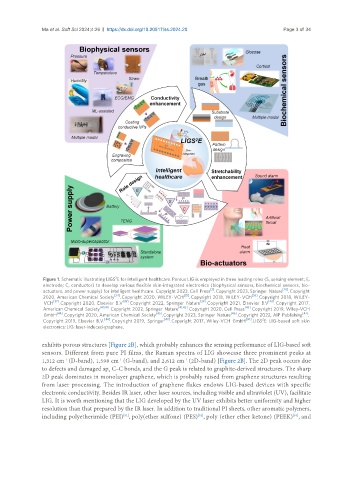
                Figure 1. Schematic illustrating LIGS E for intelligent healthcare. Porous LIG is employed in three leading roles (S, sensing element; E,
                electrode; C, conductor) to develop various flexible skin-integrated electronics (biophysical sensors, biochemical sensors, bio-
                                                                        [3]
                actuators, and power supply) for intelligent healthcare. Copyright 2023, Cell  Press . Copyright 2023, Springer  Nature [26] . Copyright
                2020, American Chemical  Society [34] . Copyright 2020, WILEY-VCH [35] . Copyright 2018, WILEY-VCH [36] . Copyright 2018, WILEY-
                VCH [37] . Copyright 2020, Elsevier  B.V [38] . Copyright 2022, Springer  Nature [39] . Copyright 2021, Elsevier  B.V [40] . Copyright 2017,
                American Chemical  Society [40,41] . Copyright 2022, Springer  Nature [41,42] . Copyright 2020, Cell  Press [43] . Copyright 2019, Wiley-VCH
                GmbH [44] . Copyright 2020, American Chemical  Society [45] . Copyright 2023, Springer  Nature [46] . Copyright 2022, AIP  Publishing [47] .
                                                                                         2
                Copyright 2019, Elsevier  B.V. [48] . Copyright 2019,  Springer [49] . Copyright 2017, Wiley-VCH  GmbH [50] . LIGS E: LIG-based soft skin
                electronics; LIG: laser-induced-graphene.

               exhibits porous structures [Figure 2B], which probably enhances the sensing performance of LIG-based soft
               sensors. Different from pure PI films, the Raman spectra of LIG showcase three prominent peaks at
                       -1
                                         -1
                                                               -1
               1,312 cm  (D-band), 1,598 cm  (G-band), and 2,612 cm  (2D-band) [Figure 2B]. The 2D peak occurs due
               to defects and damaged sp  C–C bonds, and the G peak is related to graphite-derived structures. The sharp
                                      2
               2D peak dominates in monolayer graphene, which is probably raised from graphene structures resulting
               from laser processing. The introduction of graphene flakes endows LIG-based devices with specific
               electronic conductivity. Besides IR laser, other laser sources, including visible and ultraviolet (UV), facilitate
               LIG. It is worth mentioning that the LIG developed by the UV laser exhibits better uniformity and higher
               resolution than that prepared by the IR laser. In addition to traditional PI sheets, other aromatic polymers,
                                                                                                    [53]
                                           [51]
               including polyetherimide (PEI) , poly(ether sulfone) (PES) , poly (ether ether ketone) (PEEK) , and
                                                                    [52]

