


Page 27 - Read Online
P. 27
Page 4 of 34                              Ma et al. Soft Sci 2024;4:26  https://dx.doi.org/10.20517/ss.2024.20


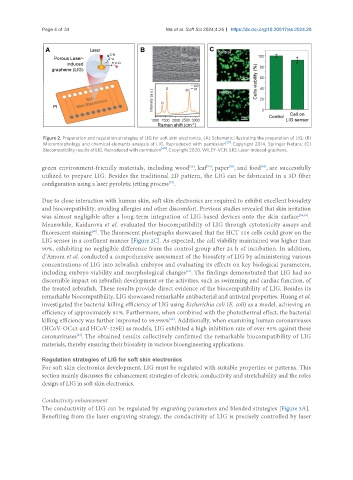
                Figure 2. Preparation and regulation strategies of LIG for soft skin electronics. (A) Schematic illustrating the preparation of LIG; (B)
                Micromorphology and chemical elements analysis of LIG. Reproduced with  permission [23] . Copyright 2014, Springer Nature; (C)
                Biocompatibility results of LIG. Reproduced with permission [60] . Copyright 2020, WILEY-VCH. LIG: Laser-induced-graphene.

               green environment-friendly materials, including wood , leaf , paper , and food , are successfully
                                                                                         [56]
                                                                 [25]
                                                                              [55]
                                                                       [54]
               utilized to prepare LIG. Besides the traditional 2D pattern, the LIG can be fabricated in a 3D fiber
                                                          [57]
               configuration using a laser pyrolytic jetting process .
               Due to close interaction with human skin, soft skin electronics are required to exhibit excellent biosafety
               and biocompatibility, avoiding allergies and other discomfort. Previous studies revealed that skin irritation
               was almost negligible after a long-term integration of LIG-based devices onto the skin surface [58,59] .
               Meanwhile, Kaidarova et al. evaluated the biocompatibility of LIG through cytotoxicity assays and
               fluorescent staining . The fluorescent photographs showcased that the HCT 116 cells could grow on the
                                [60]
               LIG sensor in a confluent manner [Figure 2C]. As expected, the cell viability maintained was higher than
               90%, exhibiting no negligible difference from the control group after 24 h of incubation. In addition,
               d’Amora et al. conducted a comprehensive assessment of the biosafety of LIG by administering various
               concentrations of LIG into zebrafish embryos and evaluating its effects on key biological parameters,
               including embryo viability and morphological changes . The findings demonstrated that LIG had no
                                                                [61]
               discernible impact on zebrafish development or the activities, such as swimming and cardiac function, of
               the treated zebrafish. These results provide direct evidence of the biocompatibility of LIG. Besides its
               remarkable biocompatibility, LIG showcased remarkable antibacterial and antiviral properties. Huang et al.
               investigated the bacterial killing efficiency of LIG using Escherichia coli (E. coli) as a model, achieving an
               efficiency of approximately 81%. Furthermore, when combined with the photothermal effect, the bacterial
                                                          [62]
               killing efficiency was further improved to 99.998% . Additionally, when examining human coronaviruses
               (HCoV-OC43 and HCoV-229E) as models, LIG exhibited a high inhibition rate of over 95% against these
                           [63]
               coronaviruses . The obtained results collectively confirmed the remarkable biocompatibility of LIG
               materials, thereby ensuring their biosafety in various bioengineering applications.

               Regulation strategies of LIG for soft skin electronics
               For soft skin electronics development, LIG must be regulated with suitable properties or patterns. This
               section mainly discusses the enhancement strategies of electric conductivity and stretchability and the roles
               design of LIG in soft skin electronics.

               Conductivity enhancement
               The conductivity of LIG can be regulated by engraving parameters and blended strategies [Figure 3A].
               Benefiting from the laser engraving strategy, the conductivity of LIG is precisely controlled by laser

