


Page 13 - Read Online
P. 13
Shen et al. Soft Sci 2023;3:20  https://dx.doi.org/10.20517/ss.2023.10          Page 11 of 14


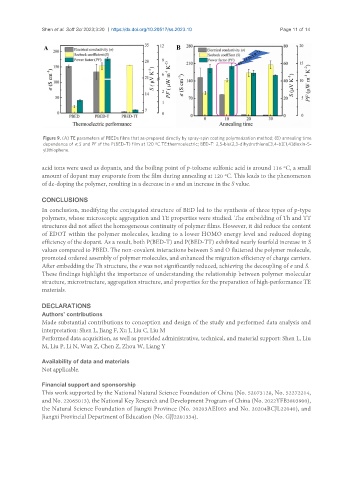
                Figure 9. (A) TE parameters of PBEDs films that as-prepared directly by spray-spin coating polymerization method; (B) annealing time
                dependence of  σ, S and PF of the P(BED-T) film at 120 ºC.TE:thermoelectric; BED-T: 2,5-bis(2,3-dihydrothieno[3,4-b][1,4]dioxin-5-
                yl)thiophene.

               acid ions were used as dopants, and the boiling point of p-toluene sulfonic acid is around 116 ºC, a small
               amount of dopant may evaporate from the film during annealing at 120 ºC. This leads to the phenomenon
               of de-doping the polymer, resulting in a decrease in σ and an increase in the S value.


               CONCLUSIONS
               In conclusion, modifying the conjugated structure of BED led to the synthesis of three types of p-type
               polymers, whose microscopic aggregation and TE properties were studied. The embedding of Th and TT
               structures did not affect the homogeneous continuity of polymer films. However, it did reduce the content
               of EDOT within the polymer molecules, leading to a lower HOMO energy level and reduced doping
               efficiency of the dopant. As a result, both P(BED-T) and P(BED-TT) exhibited nearly fourfold increase in S
               values compared to PBED. The non-covalent interactions between S and O flattened the polymer molecule,
               promoted ordered assembly of polymer molecules, and enhanced the migration efficiency of charge carriers.
               After embedding the Th structure, the σ was not significantly reduced, achieving the decoupling of σ and S.
               These findings highlight the importance of understanding the relationship between polymer molecular
               structure, microstructure, aggregation structure, and properties for the preparation of high-performance TE
               materials.


               DECLARATIONS
               Authors’ contributions
               Made substantial contributions to conception and design of the study and performed data analysis and
               interpretation: Shen L, Jiang F, Xu J, Liu C, Liu M
               Performed data acquisition, as well as provided administrative, technical, and material support: Shen L, Liu
               M, Liu P, Li N, Wan Z, Chen Z, Zhou W, Liang Y


               Availability of data and materials
               Not applicable.

               Financial support and sponsorship
               This work supported by the National Natural Science Foundation of China (No. 52073128, No. 52272214,
               and No. 22065013), the National Key Research and Development Program of China (No. 2022YFB3803900),
               the Natural Science Foundation of Jiangxi Province (No. 20203AEI003 and No. 20204BCJL22040), and
               Jiangxi Provincial Department of Education (No. GJJ2201334).

