


Page 8 - Read Online
P. 8
Page 6 of 14                            Shen et al. Soft Sci 2023;3:20  https://dx.doi.org/10.20517/ss.2023.10


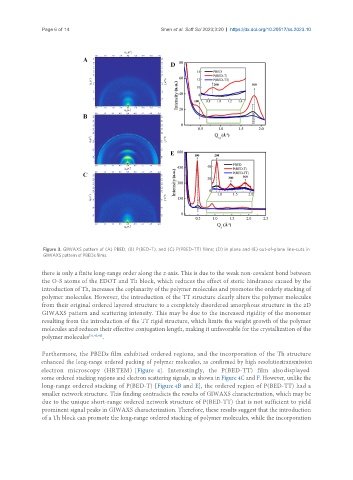
                Figure 3. GIWAXS pattern of (A) PBED, (B) P(BED-T), and (C) P(PBED-TT) films; (D) in plane and (E) out-of-plane line-cuts in
                GIWAXS pattern of PBEDs films.


               there is only a finite long-range order along the z-axis. This is due to the weak non-covalent bond between
               the O-S atoms of the EDOT and Th block, which reduces the effect of steric hindrance caused by the
               introduction of Th, increases the coplanarity of the polymer molecules and promotes the orderly stacking of
               polymer molecules. However, the introduction of the TT structure clearly alters the polymer molecules
               from their original ordered layered structure to a completely disordered amorphous structure in the 2D
               GIWAXS pattern and scattering intensity. This may be due to the increased rigidity of the monomer
               resulting from the introduction of the TT rigid structure, which limits the weight growth of the polymer
               molecules and reduces their effective conjugation length, making it unfavorable for the crystallization of the
               polymer molecules [31,45,46] .


               Furthermore, the PBEDs film exhibited ordered regions, and the incorporation of the Th structure
               enhanced the long-range ordered packing of polymer molecules, as confirmed by high resolution transmission
               electron  microscopy  (HRTEM)  [Figure  4].  Interestingly,  the  P(BED-TT)  film  also displayed
               some ordered stacking regions and electron scattering signals, as shown in Figure 4C and F. However, unlike the
               long-range ordered stacking of P(BED-T) [Figure 4B and E], the ordered region of P(BED-TT) had a
               smaller network structure. This finding contradicts the results of GIWAXS characterization, which may be
               due to the unique short-range ordered network structure of P(BED-TT) that is not sufficient to yield
               prominent signal peaks in GIWAXS characterization. Therefore, these results suggest that the introduction
               of a Th block can promote the long-range ordered stacking of polymer molecules, while the incorporation

