


Page 6 - Read Online
P. 6
Page 4 of 14                            Shen et al. Soft Sci 2023;3:20  https://dx.doi.org/10.20517/ss.2023.10


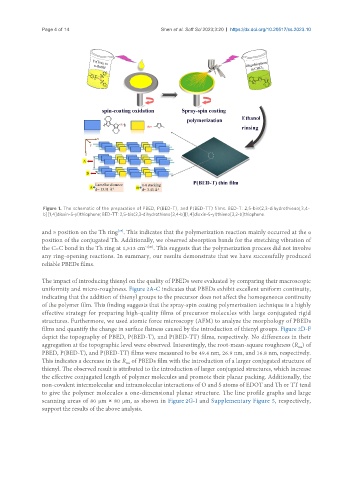
                Figure 1. The schematic of the preparation of PBED, P(BED-T), and P(BED-TT) films. BED-T: 2,5-bis(2,3-dihydrothieno[3,4-
                b][1,4]dioxin-5-yl)thiophene; BED-TT: 2,5-bis(2,3-dihydrothieno[3,4-b][1,4]dioxin-5-yl)thieno[3,2-b]thiophene.

               and 5 position on the Th ring . This indicates that the polymerization reaction mainly occurred at the α
                                         [39]
               position of the conjugated Th. Additionally, we observed absorption bands for the stretching vibration of
               the C=C bond in the Th ring at 1,513 cm -1[40] . This suggests that the polymerization process did not involve
               any ring-opening reactions. In summary, our results demonstrate that we have successfully produced
               reliable PBEDs films.

               The impact of introducing thienyl on the quality of PBEDs were evaluated by comparing their macroscopic
               uniformity and micro-roughness. Figure 2A-C indicates that PBEDs exhibit excellent uniform continuity,
               indicating that the addition of thienyl groups to the precursor does not affect the homogeneous continuity
               of the polymer film. This finding suggests that the spray-spin coating polymerization technique is a highly
               effective strategy for preparing high-quality films of precursor molecules with large conjugated rigid
               structures. Furthermore, we used atomic force microscopy (AFM) to analyze the morphology of PBEDs
               films and quantify the change in surface flatness caused by the introduction of thienyl groups. Figure 2D-F
               depict the topography of PBED, P(BED-T), and P(BED-TT) films, respectively. No differences in their
               aggregation at the topographic level were observed. Interestingly, the root-mean-square roughness (R ) of
                                                                                                      ms
               PBED, P(BED-T), and P(BED-TT) films were measured to be 49.4 nm, 26.9 nm, and 16.8 nm, respectively.
               This indicates a decrease in the R  of PBEDs film with the introduction of a larger conjugated structure of
                                           ms
               thienyl. The observed result is attributed to the introduction of larger conjugated structures, which increase
               the effective conjugated length of polymer molecules and promote their planar packing. Additionally, the
               non-covalent intermolecular and intramolecular interactions of O and S atoms of EDOT and Th or TT tend
               to give the polymer molecules a one-dimensional planar structure. The line profile graphs and large
               scanning areas of 80 μm × 80 μm, as shown in Figure 2G-I and Supplementary Figure 5, respectively,
               support the results of the above analysis.

