


Page 9 - Read Online
P. 9
Jin et al. Soft Sci 2023;3:8  https://dx.doi.org/10.20517/ss.2022.34             Page 7 of 26


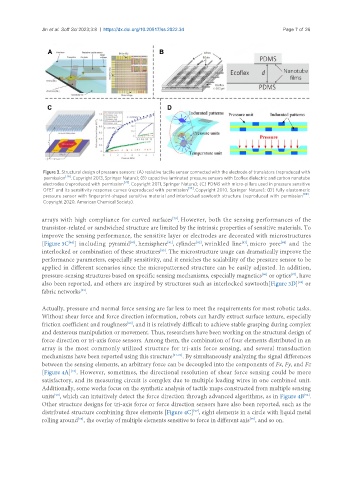
                Figure 3. Structural design of pressure sensors: (A) resistive tactile sensor connected with the electrode of transistors (reproduced with
                permission [76] . Copyright 2013, Springer Nature); (B) capacitive laminated pressure sensors with Ecoflex dielectric and carbon nanotube
                electrodes (reproduced with permission [78] . Copyright 2011, Springer Nature); (C) PDMS with micro-pillars used in pressure sensitive
                                                                [44]
                OFET and its sensitivity response curves (reproduced with  permission  . Copyright 2010, Springer Nature); (D) fully elastomeric
                                                                                                       [88]
                pressure sensor with fingerprint-shaped sensitive material and interlocked sawtooth structure (reproduced with  permission  .
                Copyright 2020, American Chemical Society).
               arrays with high compliance for curved surfaces . However, both the sensing performances of the
                                                           [79]
               transistor-related or sandwiched structure are limited by the intrinsic properties of sensitive materials. To
               improve the sensing performance, the sensitive layer or electrodes are decorated with microstructures
                                             [80]
                        [44]
                                                         [81]
                                                                   [82]
                                                                                  [83]
                                                                                                [84]
               [Figure 3C ]  including  pyramid , hemisphere , cylinder , wrinkled  line , micro  pore   and  the
               interlocked or combination of these structures . The microstructure usage can dramatically improve the
                                                       [85]
               performance parameters, especially sensitivity, and it enriches the scalability of the pressure sensor to be
               applied in different scenarios since the micropatterned structure can be easily adjusted. In addition,
               pressure-sensing structures based on specific sensing mechanisms, especially magnetics  or optics , have
                                                                                                   [87]
                                                                                         [86]
               also been reported, and others are inspired by structures such as interlocked sawtooth[Figure 3D]  or
                                                                                                     [88]
               fabric networks .
                            [89]
               Actually, pressure and normal force sensing are far less to meet the requirements for most robotic tasks.
               Without shear force and force direction information, robots can hardly extract surface texture, especially
               friction coefficient and roughness , and it is relatively difficult to achieve stable grasping during complex
                                            [90]
               and dexterous manipulation or movement. Thus, researchers have been working on the structural design of
               force direction or tri-axis force sensors. Among them, the combination of four elements distributed in an
               array is the most commonly utilized structure for tri-axis force sensing, and several transduction
               mechanisms have been reported using this structure [91-95] . By simultaneously analyzing the signal differences
               between the sensing elements, an arbitrary force can be decoupled into the components of Fx, Fy, and Fz
               [Figure 4A] . However, sometimes, the directional resolution of shear force sensing could be more
                         [10]
               satisfactory, and its measuring circuit is complex due to multiple leading wires in one combined unit.
               Additionally, some works focus on the synthetic analysis of tactile maps constructed from multiple sensing
               units , which can intuitively detect the force direction through advanced algorithms, as in Figure 4B .
                   [96]
                                                                                                        [52]
               Other structure designs for tri-axis force or force direction sensors have also been reported, such as the
               distributed structure combining three elements [Figure 4C] , eight elements in a circle with liquid metal
                                                                  [97]
                           [98]
               rolling around , the overlay of multiple elements sensitive to force in different axis , and so on.
                                                                                     [99]

