


Page 5 - Read Online
P. 5
Jin et al. Soft Sci 2023;3:8  https://dx.doi.org/10.20517/ss.2022.34             Page 3 of 26


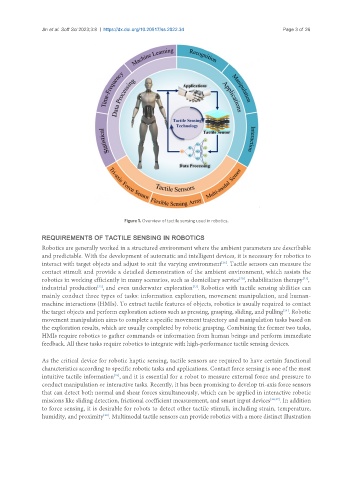
                                           Figure 1. Overview of tactile sensing used in robotics.


               REQUIREMENTS OF TACTILE SENSING IN ROBOTICS
               Robotics are generally worked in a structured environment where the ambient parameters are describable
               and predictable. With the development of automatic and intelligent devices, it is necessary for robotics to
                                                                            [16]
               interact with target objects and adjust to suit the varying environment . Tactile sensors can measure the
               contact stimuli and provide a detailed demonstration of the ambient environment, which assists the
               robotics in working efficiently in many scenarios, such as domiciliary service , rehabilitation therapy ,
                                                                                                       [21]
                                                                                  [20]
                                                                  [23]
               industrial production , and even underwater exploration . Robotics with tactile sensing abilities can
                                  [22]
               mainly conduct three types of tasks: information exploration, movement manipulation, and human-
               machine interactions (HMIs). To extract tactile features of objects, robotics is usually required to contact
               the target objects and perform exploration actions such as pressing, grasping, sliding, and pulling . Robotic
                                                                                                [24]
               movement manipulation aims to complete a specific movement trajectory and manipulation tasks based on
               the exploration results, which are usually completed by robotic grasping. Combining the former two tasks,
               HMIs require robotics to gather commands or information from human beings and perform immediate
               feedback. All these tasks require robotics to integrate with high-performance tactile sensing devices.

               As the critical device for robotic haptic sensing, tactile sensors are required to have certain functional
               characteristics according to specific robotic tasks and applications. Contact force sensing is one of the most
               intuitive tactile information , and it is essential for a robot to measure external force and pressure to
                                       [25]
               conduct manipulation or interactive tasks. Recently, it has been promising to develop tri-axis force sensors
               that can detect both normal and shear forces simultaneously, which can be applied in interactive robotic
               missions like sliding detection, frictional coefficient measurement, and smart input devices [26,27] . In addition
               to force sensing, it is desirable for robots to detect other tactile stimuli, including strain, temperature,
               humidity, and proximity . Multimodal tactile sensors can provide robotics with a more distinct illustration
                                    [28]

