


Page 8 - Read Online
P. 8
Page 6 of 26                               Jin et al. Soft Sci 2023;3:8  https://dx.doi.org/10.20517/ss.2022.34


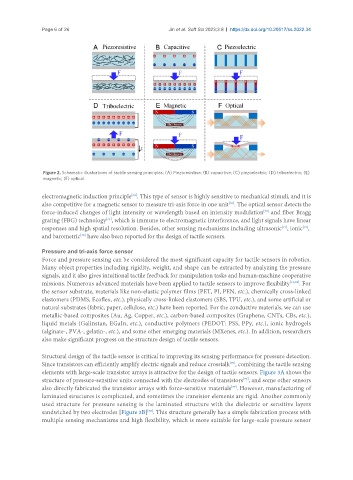
                Figure 2. Schematic illustrations of tactile sensing principles: (A) Piezoresistive; (B) capacitive; (C) piezoelectric; (D) triboelectric; (E)
                magnetic; (F) optical.

               electromagnetic induction principle . This type of sensor is highly sensitive to mechanical stimuli, and it is
                                             [68]
               also competitive for a magnetic sensor to measure tri-axis force in one unit . The optical sensor detects the
                                                                              [69]
                                                                                          [70]
               force-induced changes of light intensity or wavelength based on intensity modulation  and fiber Bragg
               grating (FBG) technology , which is immune to electromagnetic interference, and light signals have linear
                                     [71]
                                                                                                       [73]
               responses and high spatial resolution. Besides, other sensing mechanisms including ultrasonic , ionic ,
                                                                                                [72]
               and barometric  have also been reported for the design of tactile sensors.
                            [48]
               Pressure and tri-axis force sensor
               Force and pressure sensing can be considered the most significant capacity for tactile sensors in robotics.
               Many object properties including rigidity, weight, and shape can be extracted by analyzing the pressure
               signals, and it also gives intuitional tactile feedback for manipulation tasks and human-machine cooperative
               missions. Numerous advanced materials have been applied to tactile sensors to improve flexibility [13,74] . For
               the sensor substrate, materials like non-elastic polymer films (PET, PI, PEN, etc.), chemically cross-linked
               elastomers (PDMS, Ecoflex, etc.), physically cross-linked elastomers (SBS, TPU, etc.), and some artificial or
               natural substrates (fabric, paper, cellulose, etc.) have been reported. For the conductive materials, we can use
               metallic-based composites (Au, Ag, Copper, etc.), carbon-based composites (Graphene, CNTs, CBs, etc.),
               liquid metals (Galinstan, EGaIn, etc.), conductive polymers (PEDOT: PSS, PPy, etc.), ionic hydrogels
               (alginate-, PVA-, gelatin-, etc.), and some other emerging materials (MXenes, etc.). In addition, researchers
               also make significant progress on the structure design of tactile sensors.

               Structural design of the tactile sensor is critical to improving its sensing performance for pressure detection.
                                                                              [75]
               Since transistors can efficiently amplify electric signals and reduce crosstalk , combining the tactile sensing
               elements with large-scale transistor arrays is attractive for the design of tactile sensors. Figure 3A shows the
               structure of pressure-sensitive units connected with the electrodes of transistors , and some other sensors
                                                                                   [76]
                                                                               [77]
               also directly fabricated the transistor arrays with force-sensitive materials . However, manufacturing of
               laminated structures is complicated, and sometimes the transistor elements are rigid. Another commonly
               used structure for pressure sensing is the laminated structure with the dielectric or sensitive layers
               sandwiched by two electrodes [Figure 3B] . This structure generally has a simple fabrication process with
                                                   [78]
               multiple sensing mechanisms and high flexibility, which is more suitable for large-scale pressure sensor

