


Page 12 - Read Online
P. 12
Page 10 of 26                              Jin et al. Soft Sci 2023;3:8  https://dx.doi.org/10.20517/ss.2022.34


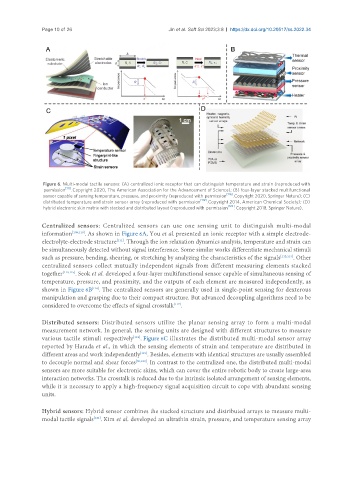
                Figure 6. Multi-modal tactile sensors: (A) centralized ionic receptor that can distinguish temperature and strain (reproduced with
                       [111]
                permission  . Copyright 2020, The American Association for the Advancement of Science); (B) four-layer stacked multifunctional
                                                                             [116]
                sensor capable of sensing temperature, pressure, and proximity (reproduced with permission  . Copyright 2020, Springer Nature); (C)
                                                                     [119]
                distributed temperature and strain sensor array (reproduced with  permission  . Copyright 2014, American Chemical Society); (D)
                                                                              [122]
                hybrid electronic skin matrix with stacked and distributed layout (reproduced with permission  . Copyright 2018, Springer Nature).
               Centralized  sensors:  Centralized  sensors  can  use  one  sensing  unit  to  distinguish  multi-modal
               information [109,110] . As shown in Figure 6A, You et al. presented an ionic receptor with a simple electrode-
               electrolyte-electrode structure . Through the ion relaxation dynamics analysis, temperature and strain can
                                        [111]
               be simultaneously detected without signal interference. Some similar works differentiate mechanical stimuli
               such as pressure, bending, shearing, or stretching by analyzing the characteristics of the signals [112,113] . Other
               centralized sensors collect mutually independent signals from different measuring elements stacked
               together [114,115] . Seok et al. developed a four-layer multifunctional sensor capable of simultaneous sensing of
               temperature, pressure, and proximity, and the outputs of each element are measured independently, as
               shown in Figure 6B . The centralized sensors are generally used in single-point sensing for dexterous
                                [116]
               manipulation and grasping due to their compact structure. But advanced decoupling algorithms need to be
                                                            [117]
               considered to overcome the effects of signal crosstalk .
               Distributed sensors: Distributed sensors utilize the planar sensing array to form a multi-modal
               measurement network. In general, the sensing units are designed with different structures to measure
               various tactile stimuli respectively . Figure 6C illustrates the distributed multi-modal sensor array
                                              [118]
               reported by Harada et al., in which the sensing elements of strain and temperature are distributed in
               different areas and work independently . Besides, elements with identical structures are usually assembled
                                                [119]
               to decouple normal and shear forces [60,120] . In contrast to the centralized one, the distributed multi-modal
               sensors are more suitable for electronic skins, which can cover the entire robotic body to create large-area
               interaction networks. The crosstalk is reduced due to the intrinsic isolated arrangement of sensing elements,
               while it is necessary to apply a high-frequency signal acquisition circuit to cope with abundant sensing
               units.


               Hybrid sensors: Hybrid sensor combines the stacked structure and distributed arrays to measure multi-
                                 [121]
               modal tactile signals . Kim et al. developed an ultrathin strain, pressure, and temperature sensing array

