


Page 14 - Read Online
P. 14
Page 12 of 26                              Jin et al. Soft Sci 2023;3:8  https://dx.doi.org/10.20517/ss.2022.34

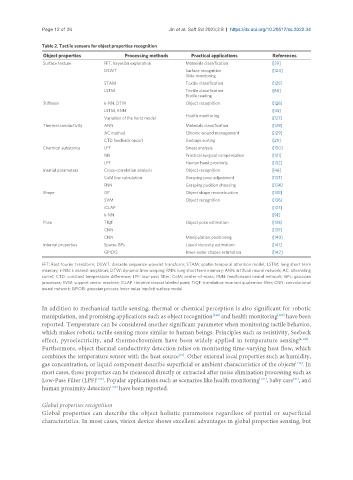
               Table 2. Tactile sensors for object properties recognition
                Object properties          Processing methods     Practical applications     References
                Surface texture     FFT, bayesian exploration   Materials classification     [39]
                                    DSWT                        Surface recognition          [124]
                                                                Slide monitoring
                                    STAM                        Textile classification       [125]
                                    LSTM                        Textile classification       [66]
                                                                Braille reading
                Stiffness           k-NN, DTW                   Object recognition           [126]
                                    LSTM, RNN                                                [43]
                                                                Health monitoring
                                    Variation of the hertz model                             [127]
                Thermal conductivity  ANN                       Materials classification     [128]
                                    AC method                   Chronic wound management     [129]
                                    CTD feedback circuit        Garbage sorting              [29]
                Chemical substance  LPF                         Sweat analysis               [130]
                                    NN                          Practical surgical compensation  [131]
                                    LPF                         Human hand proximity         [132]
                Inertial parameters  Cross-correlation analysis  Object recognition          [46]
                                    CoM line calculation        Grasping pose adjustment     [133]
                                    FNN                         Grasping position choosing   [134]
                Shape               GP                          Object shape reconstruction  [135]
                                    SVM                         Object recognition           [136]
                                    iCLAP                                                    [137]
                                    k-NN                                                     [91]
                Pose                TIQF                        Object pose estimation       [138]
                                    CNN                                                      [139]
                                    CNN                         Manipulation positioning     [140]
                Internal properties  Sparse GPs                 Liquid viscosity estimation  [141]
                                    GPIOIS                      Inner-outer shapes estimation  [142]
               FFT: Fast fourier transform; DSWT: discrete sequence wavelet transform; STAM: spatio-temporal attention model; LSTM: long short term
               memory; k-NN: k nearest neighbors; DTW: dynamic time warping; RNN: long short term memory; ANN: artificial neural network; AC: alternating
               curret; CTD: constant temperature difference; LPF: low-pass filter; CoM: center-of-mass; FNN: feedforward neural network; GPs: gaussian
               processes; SVM: support vector machine; iCLAP: iterative closest labeled point; TIQF: translation-invariant quaternion filter; CNN: convolutional
               neural network; GPIOIS: gaussian process inner-outer implicit surface model.


               In addition to mechanical tactile sensing, thermal or chemical perception is also significant for robotic
               manipulation, and promising applications such as object recognition  and health monitoring  have been
                                                                                               [129]
                                                                         [148]
               reported. Temperature can be considered another significant parameter when monitoring tactile behavior,
               which makes robotic tactile sensing more similar to human beings. Principles such as resistivity, Seebeck
               effect, pyroelectricity, and thermochromism have been widely applied in temperature sensing [4,108] .
               Furthermore, object thermal conductivity detection relies on monitoring time-varying heat flow, which
               combines the temperature sensor with the heat source . Other external local properties such as humidity,
                                                             [29]
                                                                                                     [149]
               gas concentration, or liquid component describe superficial or ambient characteristics of the objects . In
               most cases, these properties can be measured directly or extracted after noise elimination processing such as
                                                                                                    [51]
                                                                                        [131]
               Low-Pass Filter (LPF) . Popular applications such as scenarios like health monitoring , baby care , and
                                  [130]
               human proximity detection  have been reported.
                                      [132]
               Global properties recognition
               Global properties can describe the object holistic parameters regardless of partial or superficial
               characteristics. In most cases, vision device shows excellent advantages in global properties sensing, but

