


Page 19 - Read Online
P. 19
Jin et al. Soft Sci 2023;3:8  https://dx.doi.org/10.20517/ss.2022.34            Page 17 of 26


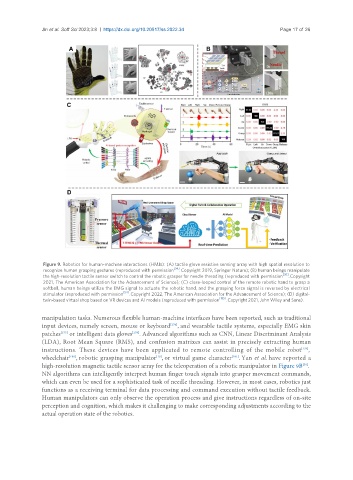
                Figure 9. Robotics for human-machine interactions (HMIs): (A) tactile glove resistive sensing array with high spatial resolution to
                                                            [34]
                recognize human grasping gestures (reproduced with permission  . Copyright 2019, Springer Nature); (B) human beings manipulate
                the high-resolution tactile sensor switch to control the robotic grasper for needle threading (reproduced with permission [30] . Copyright
                2021, The American Association for the Advancement of Science); (C) close-looped control of the remote robotic hand to grasp a
                softball, human beings utilize the EMG signal to actuate the robotic hand, and the grasping force signal is reversed by electrical
                stimulator (reproduced with permission [54] . Copyright 2022, The American Association for the Advancement of Science); (D) digital-
                twin-based virtual shop based on VR devices and AI models (reproduced with permission [185] . Copyright 2021, John Wiley and Sons).

               manipulation tasks. Numerous flexible human-machine interfaces have been reported, such as traditional
               input devices, namely screen, mouse or keyboard , and wearable tactile systems, especially EMG skin
                                                          [176]
               patches  or intelligent data gloves . Advanced algorithms such as CNN, Linear Discriminant Analysis
                                              [178]
                     [177]
               (LDA), Root Mean Square (RMS), and confusion matrixes can assist in precisely extracting human
               instructions.  These  devices  have  been  applicated  to  remote  controlling  of  the  mobile  robot ,
                                                                                                       [179]
                        [180]
                                                      [19]
               wheelchair , robotic grasping manipulator , or virtual game character . Yan et al. have reported a
                                                                               [181]
               high-resolution magnetic tactile sensor array for the teleoperation of a robotic manipulator in Figure 9B .
                                                                                                       [30]
               NN algorithms can intelligently interpret human finger touch signals into grasper movement commands,
               which can even be used for a sophisticated task of needle threading. However, in most cases, robotics just
               functions as a receiving terminal for data processing and command execution without tactile feedback.
               Human manipulators can only observe the operation process and give instructions regardless of on-site
               perception and cognition, which makes it challenging to make corresponding adjustments according to the
               actual operation state of the robotics.

