


Page 17 - Read Online
P. 17
Jin et al. Soft Sci 2023;3:8  https://dx.doi.org/10.20517/ss.2022.34            Page 15 of 26


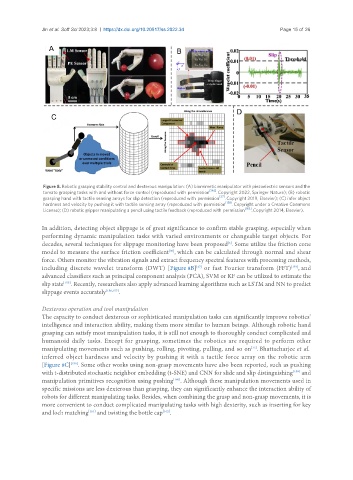
                Figure 8. Robotic grasping stability control and dexterous manipulation: (A) biomimetic manipulator with piezoelectric sensors and the
                                                                        [146]
                tomato grasping tasks with and without force control (reproduced with  permission  . Copyright 2022, Springer Nature); (B) robotic
                                                                           [27]
                grasping hand with tactile sensing arrays for slip detection (reproduced with permission  . Copyright 2019, Elsevier); (C) infer object
                hardness and velocity by pushing it with tactile sensing array (reproduced with  permission [158] . Copyright under a Creative Commons
                License); (D) robotic gripper manipulating a pencil using tactile feedback (reproduced with permission [163] . Copyright 2014, Elsevier).
               In addition, detecting object slippage is of great significance to confirm stable grasping, especially when
               performing dynamic manipulation tasks with varied environments or changeable target objects. For
               decades, several techniques for slippage monitoring have been proposed . Some utilize the friction cone
                                                                              [5]
                                                          [30]
               model to measure the surface friction coefficient , which can be calculated through normal and shear
               force. Others monitor the vibration signals and extract frequency spectral features with processing methods,
                                                                                                   [154]
               including discrete wavelet transform (DWT) [Figure 8B]  or fast Fourier transform (FFT) , and
                                                                   [27]
               advanced classifiers such as principal component analysis (PCA), SVM or KF can be utilized to estimate the
                      [155]
               slip state . Recently, researchers also apply advanced learning algorithms such as LSTM and NN to predict
               slippage events accurately [156,157] .
               Dexterous operation and tool manipulation
               The capacity to conduct dexterous or sophisticated manipulation tasks can significantly improve robotics’
               intelligence and interaction ability, making them more similar to human beings. Although robotic hand
               grasping can satisfy most manipulation tasks, it is still not enough to thoroughly conduct complicated and
               humanoid daily tasks. Except for grasping, sometimes the robotics are required to perform other
               manipulating movements such as pushing, rolling, pivoting, pulling, and so on . Bhattacharjee et al.
                                                                                      [17]
               inferred object hardness and velocity by pushing it with a tactile force array on the robotic arm
               [Figure 8C] . Some other works using non-grasp movements have also been reported, such as pushing
                         [158]
               with t-distributed stochastic neighbor embedding (t-SNE) and CNN for slide and slip distinguishing  and
                                                                                                    [159]
               manipulation primitives recognition using pushing . Although these manipulation movements used in
                                                           [160]
               specific missions are less dexterous than grasping, they can significantly enhance the interaction ability of
               robots for different manipulating tasks. Besides, when combining the grasp and non-grasp movements, it is
               more convenient to conduct complicated manipulating tasks with high dexterity, such as inserting for key
                                                        [162]
                               [161]
               and loch matching  and twisting the bottle cap .

