


Page 10 - Read Online
P. 10
Page 8 of 26                               Jin et al. Soft Sci 2023;3:8  https://dx.doi.org/10.20517/ss.2022.34


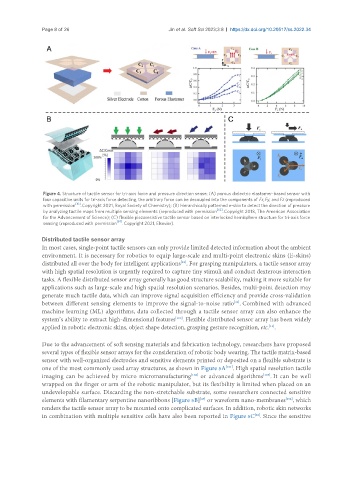
                Figure 4. Structure of tactile sensor for tri-axis force and pressure direction sense: (A) porous dielectric elastomer-based sensor with
                four capacitive units for tri-axis force detecting, the arbitrary force can be decoupled into the components of Fx, Fy, and Fz (reproduced
                          [10]
                with permission  . Copyright 2021, Royal Society of Chemistry); (B) hierarchically patterned e-skin to detect the direction of pressure
                by analyzing tactile maps from multiple sensing elements (reproduced with permission [52] . Copyright 2018, The American Association
                for the Advancement of Science); (C) flexible piezoresistive tactile sensor based on interlocked hemisphere structure for tri-axis force
                sensing (reproduced with permission [97] . Copyright 2021, Elsevier).

               Distributed tactile sensor array
               In most cases, single-point tactile sensors can only provide limited detected information about the ambient
               environment. It is necessary for robotics to equip large-scale and multi-point electronic skins (E-skins)
               distributed all over the body for intelligent applications . For grasping manipulators, a tactile sensor array
                                                              [22]
               with high spatial resolution is urgently required to capture tiny stimuli and conduct dexterous interaction
               tasks. A flexible distributed sensor array generally has good structure scalability, making it more suitable for
               applications such as large-scale and high spatial resolution scenarios. Besides, multi-point detection may
               generate much tactile data, which can improve signal acquisition efficiency and provide cross-validation
               between different sensing elements to improve the signal-to-noise ratio . Combined with advanced
                                                                                [33]
               machine learning (ML) algorithms, data collected through a tactile sensor array can also enhance the
               system’s ability to extract high-dimensional features . Flexible distributed sensor array has been widely
                                                            [100]
               applied in robotic electronic skins, object shape detection, grasping gesture recognition, etc. .
                                                                                            [11]

               Due to the advancement of soft sensing materials and fabrication technology, researchers have proposed
               several types of flexible sensor arrays for the consideration of robotic body wearing. The tactile matrix-based
               sensor with well-organized electrodes and sensitive elements printed or deposited on a flexible substrate is
               one of the most commonly used array structures, as shown in Figure 5A . High spatial resolution tactile
                                                                             [101]
               imaging can be achieved by micro micromanufacturing  or advanced algorithms . It can be well
                                                                                          [103]
                                                                 [102]
               wrapped on the finger or arm of the robotic manipulator, but its flexibility is limited when placed on an
               undevelopable surface. Discarding the non-stretchable substrate, some researchers connected sensitive
               elements with filamentary serpentine nanoribbons [Figure 5B]  or waveform nano-membranes , which
                                                                    [47]
                                                                                                 [104]
               renders the tactile sensor array to be mounted onto complicated surfaces. In addition, robotic skin networks
               in combination with multiple sensitive cells have also been reported in Figure 5C . Since the sensitive
                                                                                       [22]

