


Page 84 - Read Online
P. 84
Page 18 of 25                        Nagwade et al. Soft Sci 2023;3:24  https://dx.doi.org/10.20517/ss.2023.12

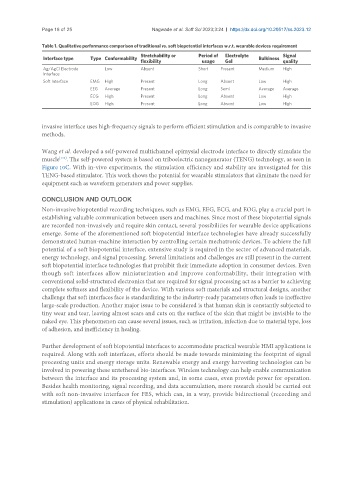
               Table 1. Qualitative performance comparison of traditional vs. soft biopotential interfaces w.r.t. wearable devices requirement
                                                Stretchability or   Period of   Electrolyte     Signal
                Interface type  Type Conformability                                     Bulkiness
                                                flexibility          usage   Gel                quality
                Ag/AgCl Electrode   Low         Absent              Short  Present      Medium  High
                Interface
                Soft Interface  EMG  High       Present             Long   Absent       Low     High
                               EEG  Average     Present             Long   Semi         Average  Average
                               ECG  High        Present             Long   Absent       Low     High
                               EOG  High        Present             Long   Absent       Low     High


               invasive interface uses high-frequency signals to perform efficient stimulation and is comparable to invasive
               methods.

               Wang et al. developed a self-powered multichannel epimysial electrode interface to directly stimulate the
               muscle . The self-powered system is based on triboelectric nanogenerator (TENG) technology, as seen in
                     [125]
               Figure 10C. With in-vivo experiments, the stimulation efficiency and stability are investigated for this
               TENG-based stimulator. This work shows the potential for wearable stimulators that eliminate the need for
               equipment such as waveform generators and power supplies.


               CONCLUSION AND OUTLOOK
               Non-invasive biopotential recording techniques, such as EMG, EEG, ECG, and EOG, play a crucial part in
               establishing valuable communication between users and machines. Since most of these biopotential signals
               are recorded non-invasively and require skin contact, several possibilities for wearable device applications
               emerge. Some of the aforementioned soft biopotential interface technologies have already successfully
               demonstrated human-machine interaction by controlling certain mechatronic devices. To achieve the full
               potential of a soft biopotential interface, extensive study is required in the sector of advanced materials,
               energy technology, and signal processing. Several limitations and challenges are still present in the current
               soft biopotential interface technologies that prohibit their immediate adoption in consumer devices. Even
               though soft interfaces allow miniaturization and improve conformability, their integration with
               conventional solid-structured electronics that are required for signal processing act as a barrier to achieving
               complete softness and flexibility of the device. With various soft materials and structural designs, another
               challenge that soft interfaces face is standardizing to the industry-ready parameters often leads to ineffective
               large-scale production. Another major issue to be considered is that human skin is constantly subjected to
               tiny wear and tear, leaving almost scars and cuts on the surface of the skin that might be invisible to the
               naked eye. This phenomenon can cause several issues, such as irritation, infection due to material type, loss
               of adhesion, and inefficiency in healing.


               Further development of soft biopotential interfaces to accommodate practical wearable HMI applications is
               required. Along with soft interfaces, efforts should be made towards minimizing the footprint of signal
               processing units and energy storage units. Renewable energy and energy harvesting technologies can be
               involved in powering these untethered bio-interfaces. Wireless technology can help enable communication
               between the interface and its processing system and, in some cases, even provide power for operation.
               Besides health monitoring, signal recording, and data accumulation, more research should be carried out
               with soft non-invasive interfaces for FES, which can, in a way, provide bidirectional (recording and
               stimulation) applications in cases of physical rehabilitation.

