


Page 81 - Read Online
P. 81
Nagwade et al. Soft Sci 2023;3:24  https://dx.doi.org/10.20517/ss.2023.12       Page 15 of 25


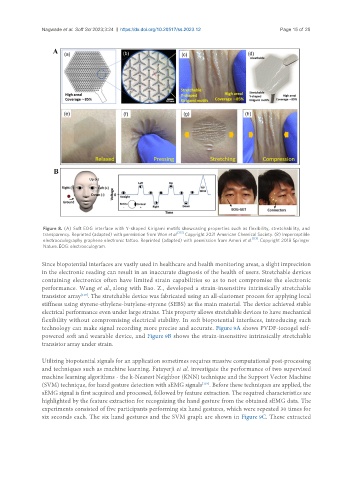
                Figure 8. (A) Soft EOG interface with Y-shaped Kirigami motifs showcasing properties such as flexibility, stretchability, and
                transparency. Reprinted (adapted) with permission from Won et al. [112]  Copyright 2021 American Chemical Society. (B) Imperceptible
                electrooculography graphene electronic tattoo. Reprinted (adapted) with permission from Ameri  et al. [113] . Copyright 2018 Springer
                Nature. EOG: electrooculogram.


               Since biopotential interfaces are vastly used in healthcare and health monitoring areas, a slight imprecision
               in the electronic reading can result in an inaccurate diagnosis of the health of users. Stretchable devices
               containing electronics often have limited strain capabilities so as to not compromise the electronic
               performance. Wang et al., along with Bao. Z., developed a strain-insensitive intrinsically stretchable
               transistor array . The stretchable device was fabricated using an all-elastomer process for applying local
                            [118]
               stiffness using styrene-ethylene-butylene-styrene (SEBS) as the main material. The device achieved stable
               electrical performance even under large strains. This property allows stretchable devices to have mechanical
               flexibility without compromising electrical stability. In soft biopotential interfaces, introducing such
               technology can make signal recording more precise and accurate. Figure 9A shows PVDF-ionogel self-
               powered soft and wearable device, and Figure 9B shows the strain-insensitive intrinsically stretchable
               transistor array under strain.

               Utilizing biopotential signals for an application sometimes requires massive computational post-processing
               and techniques such as machine learning. Fatayerji et al. investigate the performance of two supervised
               machine learning algorithms - the k-Nearest Neighbor (KNN) technique and the Support Vector Machine
               (SVM) technique, for hand gesture detection with sEMG signals . Before these techniques are applied, the
                                                                     [119]
               sEMG signal is first acquired and processed, followed by feature extraction. The required characteristics are
               highlighted by the feature extraction for recognizing the hand gesture from the obtained sEMG data. The
               experiments consisted of five participants performing six hand gestures, which were repeated 30 times for
               six seconds each. The six hand gestures and the SVM graph are shown in Figure 9C. These extracted

