


Page 79 - Read Online
P. 79
Nagwade et al. Soft Sci 2023;3:24  https://dx.doi.org/10.20517/ss.2023.12       Page 13 of 25


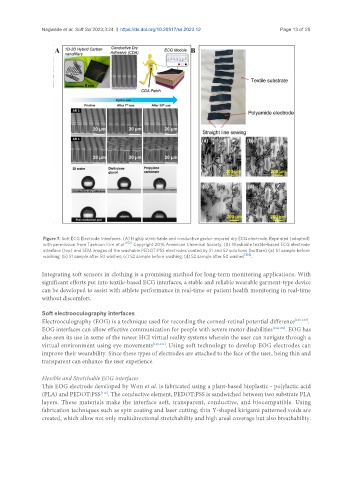
                Figure 7. Soft ECG Electrode Interfaces: (A) Highly stretchable and conductive gecko-inspired dry ECG electrode. Reprinted (adapted)
                with permission from Taehoon Kim et al. [103] . Copyright 2016 American Chemical Society. (B) Washable textile-based ECG electrode
                interface (top) and SEM images of the washable PEDOT:PSS electrodes coated by S1 and S2 solutions (bottom) (a) S1 sample before
                washing; (b) S1 sample after 50 washes; (c) S2 sample before washing; (d) S2 sample after 50 washes [104] .

               Integrating soft sensors in clothing is a promising method for long-term monitoring applications. With
               significant efforts put into textile-based ECG interfaces, a stable and reliable wearable garment-type device
               can be developed to assist with athlete performance in real-time or patient health monitoring in real-time
               without discomfort.


               Soft electrooculography interfaces
               Electrooculography (EOG) is a technique used for recording the corneal-retinal potential difference [105-107] .
               EOG interfaces can allow effective communication for people with severe motor disabilities [108,109] . EOG has
               also seen its use in some of the newer HCI virtual reality systems wherein the user can navigate through a
               virtual environment using eye movements [110,111] . Using soft technology to develop EOG electrodes can
               improve their wearability. Since these types of electrodes are attached to the face of the user, being thin and
               transparent can enhance the user experience.


               Flexible and Stretchable EOG interfaces
               This EOG electrode developed by Won et al. is fabricated using a plant-based bioplastic - polylactic acid
                                   [112]
               (PLA) and PEDOT:PSS . The conductive element, PEDOT:PSS is sandwiched between two substrate PLA
               layers. These materials make the interface soft, transparent, conductive, and biocompatible. Using
               fabrication techniques such as spin coating and laser cutting, thin Y-shaped kirigami patterned voids are
               created, which allow not only multidirectional stretchability and high areal coverage but also breathability.

