


Page 75 - Read Online
P. 75
Nagwade et al. Soft Sci 2023;3:24  https://dx.doi.org/10.20517/ss.2023.12        Page 9 of 25


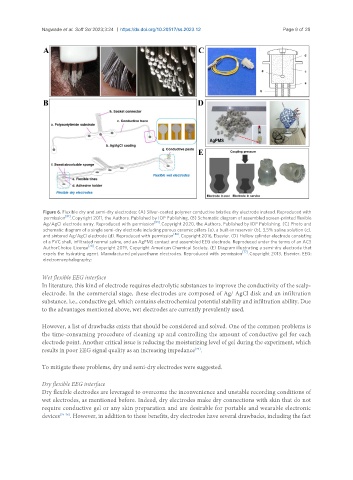
                Figure 6. Flexible dry and semi-dry electrodes: (A) Silver-coated polymer conductive bristles dry electrode instead. Reproduced with
                       [81]
                permission  . Copyright 2011, the Authors. Published by IOP Publishing. (B) Schematic diagram of assembled screen-printed flexible
                                                     [83]
                Ag/AgCl electrode array. Reproduced with  permission  . Copyright 2020, the Authors. Published by IOP Publishing. (C) Photo and
                schematic diagram of a single semi-dry electrode including porous ceramic pillars (a), a built-in reservoir (b), 3.5% saline solution (c),
                                                           [86]
                and sintered Ag/AgCl electrode (d). Reproduced with permission  . Copyright 2016, Elsevier. (D) Hollow cylinder electrode consisting
                of a PVC shell, infiltrated normal saline, and an AgPMS contact and assembled EEG electrode. Reproduced under the terms of an ACS
                AuthorChoice  License [78] . Copyright 2019, Copyright American Chemical Society. (E) Diagram illustrating a semi-dry electrode that
                expels the hydrating agent. Manufactured polyurethane electrodes. Reproduced with  permission [77] . Copyright 2013, Elsevier. EEG:
                electroencephalography;

               Wet flexible EEG interface
               In literature, this kind of electrode requires electrolytic substances to improve the conductivity of the scalp-
               electrode. In the commercial stage, these electrodes are composed of Ag/ AgCl disk and an infiltration
               substance, i.e., conductive gel, which contains electrochemical potential stability and infiltration ability. Due
               to the advantages mentioned above, wet electrodes are currently prevalently used.


               However, a list of drawbacks exists that should be considered and solved. One of the common problems is
               the time-consuming procedure of cleaning up and controlling the amount of conductive gel for each
               electrode point. Another critical issue is reducing the moisturizing level of gel during the experiment, which
               results in poor EEG signal quality as an increasing impedance .
                                                                   [73]
               To mitigate these problems, dry and semi-dry electrodes were suggested.


               Dry flexible EEG interface
               Dry flexible electrodes are leveraged to overcome the inconvenience and unstable recording conditions of
               wet electrodes, as mentioned before. Indeed, dry electrodes make dry connections with skin that do not
               require conductive gel or any skin preparation and are desirable for portable and wearable electronic
               devices [74-76] . However, in addition to these benefits, dry electrodes have several drawbacks, including the fact

