


Page 72 - Read Online
P. 72
Page 6 of 25                         Nagwade et al. Soft Sci 2023;3:24  https://dx.doi.org/10.20517/ss.2023.12


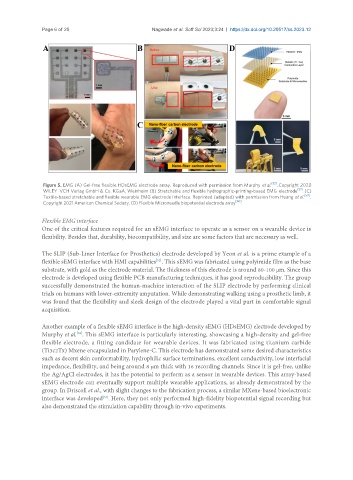
                Figure 5. EMG (A) Gel-free flexible HDsEMG electrode array. Reproduced with permission from Murphy  et al. [52] . Copyright 2020
                WILEY VCH Verlag GmbH & Co. KGaA, Weinheim (B) Stretchable and flexible hydrographic-printing-based EMG  electrode [57] . (C)
                Textile-based stretchable and flexible wearable EMG electrode interface. Reprinted (adapted) with permission from Huang  et al. [59] .
                Copyright 2021 American Chemical Society. (D) Flexible Microneedle biopotential electrode array [60] .


               Flexible EMG interface
               One of the critical features required for an sEMG interface to operate as a sensor on a wearable device is
               flexibility. Besides that, durability, biocompatibility, and size are some factors that are necessary as well.

               The SLIP (Sub-Liner Interface for Prosthetics) electrode developed by Yeon et al. is a prime example of a
               flexible sEMG interface with HMI capabilities . This sEMG was fabricated using polyimide film as the base
                                                      [51]
               substrate, with gold as the electrode material. The thickness of this electrode is around 80-100 μm. Since this
               electrode is developed using flexible PCB manufacturing techniques, it has good reproducibility. The group
               successfully demonstrated the human-machine interaction of the SLIP electrode by performing clinical
               trials on humans with lower-extremity amputation. While demonstrating walking using a prosthetic limb, it
               was found that the flexibility and sleek design of the electrode played a vital part in comfortable signal
               acquisition.


               Another example of a flexible sEMG interface is the high-density sEMG (HDsEMG) electrode developed by
               Murphy et al. . This sEMG interface is particularly interesting, showcasing a high-density and gel-free
                           [52]
               flexible electrode, a fitting candidate for wearable devices. It was fabricated using titanium carbide
               (Ti3c2Tx) Mxene encapsulated in Parylene-C. This electrode has demonstrated some desired characteristics
               such as decent skin conformability, hydrophilic surface terminations, excellent conductivity, low interfacial
               impedance, flexibility, and being around 8 μm thick with 16 recording channels. Since it is gel-free, unlike
               the Ag/AgCl electrodes, it has the potential to perform as a sensor in wearable devices. This array-based
               sEMG electrode can eventually support multiple wearable applications, as already demonstrated by the
               group. In Driscoll et al., with slight changes to the fabrication process, a similar MXene-based bioelectronic
                                    [53]
               interface was developed . Here, they not only performed high-fidelity biopotential signal recording but
               also demonstrated the stimulation capability through in-vivo experiments.

