


Page 69 - Read Online
P. 69
Nagwade et al. Soft Sci 2023;3:24  https://dx.doi.org/10.20517/ss.2023.12        Page 3 of 25


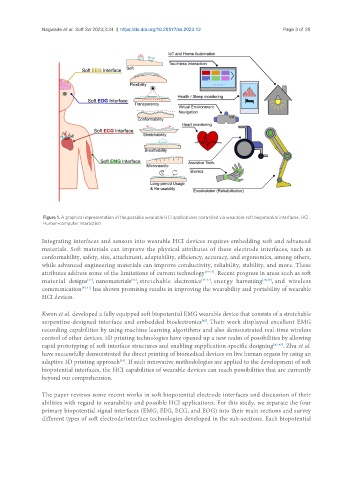
                Figure 1. A graphical representation of the possible wearable HCI applications controlled via wearable soft biopotential interfaces. HCI:
                Human-computer interaction.

               Integrating interfaces and sensors into wearable HCI devices requires embedding soft and advanced
               materials. Soft materials can improve the physical attributes of these electrode interfaces, such as
               conformability, safety, size, attachment, adaptability, efficiency, accuracy, and ergonomics, among others,
               while advanced engineering materials can improve conductivity, reliability, stability, and more. These
               attributes address some of the limitations of current technology [29-31] . Recent progress in areas such as soft
                              [32]
                                             [33]
               material  designs , nanomaterials , stretchable  electronics [34-37] , energy  harvesting [38,39] , and  wireless
               communication [40,41]  has shown promising results in improving the wearability and portability of wearable
               HCI devices.

               Kwon et al. developed a fully equipped soft biopotential EMG wearable device that consists of a stretchable
               serpentine-designed interface and embedded bioelectronics . Their work displayed excellent EMG
                                                                     [42]
               recording capabilities by using machine learning algorithms and also demonstrated real-time wireless
               control of other devices. 3D printing technologies have opened up a new realm of possibilities by allowing
               rapid prototyping of soft interface structures and enabling supplication-specific designing [43-45] . Zhu et al.
               have successfully demonstrated the direct printing of biomedical devices on live human organs by using an
               adaptive 3D printing approach . If such innovative methodologies are applied to the development of soft
                                         [46]
               biopotential interfaces, the HCI capabilities of wearable devices can reach possibilities that are currently
               beyond our comprehension.

               The paper reviews some recent works in soft biopotential electrode interfaces and discussion of their
               abilities with regard to wearability and possible HCI applications. For this study, we separate the four
               primary biopotential signal interfaces (EMG, EEG, ECG, and EOG) into their main sections and survey
               different types of soft electrode/interface technologies developed in the sub-sections. Each biopotential

