


Page 111 - Read Online
P. 111
Page 14 of 19                        Hussain et al. Soft Sci. 2025, 5, 21  https://dx.doi.org/10.20517/ss.2025.02


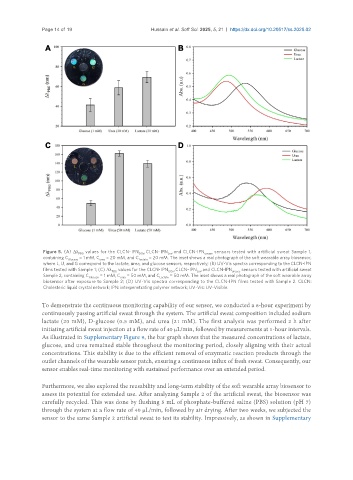
                Figure 5. (A) Δλ   values for the CLCN-IPN  , CLCN-IPN , and CLCN-IPN   sensors tested with artificial sweat Sample 1,
                           PBG                  GOx       Lox         urease
                containing C   = 1 mM, C   = 20 mM, and C   = 20 mM. The inset shows a real photograph of the soft wearable array biosensor,
                        Glucose    urea         Lactate
                where L, U, and G correspond to the lactate, urea, and glucose sensors, respectively; (B) UV-Vis spectra corresponding to the CLCN-IPN
                films tested with Sample 1; (C) Δλ   values for the CLCN-IPN  , CLCN-IPN , and CLCN-IPN   sensors tested with artificial sweat
                                       PBG                GOx      Lox         urease
                Sample 2, containing C   = 1 mM, C   = 50 mM, and C   = 50 mM. The inset shows a real photograph of the soft wearable array
                               Glucose    urea         Lactate
                biosensor after exposure to Sample 2; (D) UV-Vis spectra corresponding to the CLCN-IPN films tested with Sample 2. CLCN:
                Cholesteric liquid crystal network; IPN: interpenetrating polymer network; UV-Vis: UV-Visible.
               To demonstrate the continuous monitoring capability of our sensor, we conducted a 6-hour experiment by
               continuously passing artificial sweat through the system. The artificial sweat composition included sodium
               lactate (20 mM), D-glucose (0.5 mM), and urea (21 mM). The first analysis was performed 2 h after
               initiating artificial sweat injection at a flow rate of 40 µL/min, followed by measurements at 1-hour intervals.
               As illustrated in Supplementary Figure 9, the bar graph shows that the measured concentrations of lactate,
               glucose, and urea remained stable throughout the monitoring period, closely aligning with their actual
               concentrations. This stability is due to the efficient removal of enzymatic reaction products through the
               outlet channels of the wearable sensor patch, ensuring a continuous influx of fresh sweat. Consequently, our
               sensor enables real-time monitoring with sustained performance over an extended period.

               Furthermore, we also explored the reusability and long-term stability of the soft wearable array biosensor to
               assess its potential for extended use. After analyzing Sample 2 of the artificial sweat, the biosensor was
               carefully recycled. This was done by flushing 5 mL of phosphate-buffered saline (PBS) solution (pH 7)
               through the system at a flow rate of 40 µL/min, followed by air drying. After two weeks, we subjected the
               sensor to the same Sample 2 artificial sweat to test its stability. Impressively, as shown in Supplementary

