


Page 108 - Read Online
P. 108
Hussain et al. Soft Sci. 2025, 5, 21  https://dx.doi.org/10.20517/ss.2025.02    Page 11 of 19


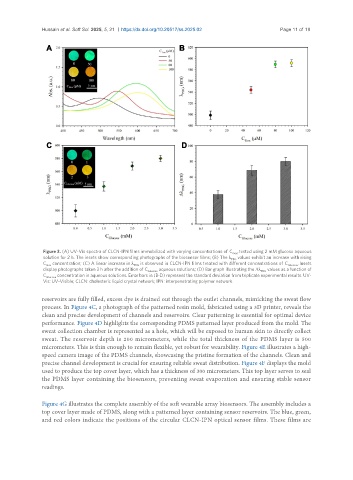
                Figure 3. (A) UV-Vis spectra of CLCN-IPN films immobilized with varying concentrations of  C Gox , tested using 2 mM glucose aqueous
                solution for 2 h. The insets show corresponding photographs of the biosensor films; (B) The λ PBG  values exhibit an increase with rising
                C Gox  concentration; (C) A linear increase in λ PBG  is observed in CLCN-IPN films treated with different concentrations of  C Glucose . Insets
                display photographs taken 2 h after the addition of C Glucose  aqueous solutions; (D) Bar graph illustrating the Δλ PBG  values as a function of
                C Glucose  concentration in aqueous solutions. Error bars in (B-D) represent the standard deviation from triplicate experimental results. UV-
                Vis: UV-Visible; CLCN: cholesteric liquid crystal network; IPN: interpenetrating polymer network.

               reservoirs are fully filled, excess dye is drained out through the outlet channels, mimicking the sweat flow
               process. In Figure 4C, a photograph of the patterned resin mold, fabricated using a 3D printer, reveals the
               clean and precise development of channels and reservoirs. Clear patterning is essential for optimal device
               performance. Figure 4D highlights the corresponding PDMS patterned layer produced from the mold. The
               sweat collection chamber is represented as a hole, which will be exposed to human skin to directly collect
               sweat. The reservoir depth is 200 micrometers, while the total thickness of the PDMS layer is 500
               micrometers. This is thin enough to remain flexible, yet robust for wearability. Figure 4E illustrates a high-
               speed camera image of the PDMS channels, showcasing the pristine formation of the channels. Clean and
               precise channel development is crucial for ensuring reliable sweat distribution. Figure 4F displays the mold
               used to produce the top cover layer, which has a thickness of 300 micrometers. This top layer serves to seal
               the PDMS layer containing the biosensors, preventing sweat evaporation and ensuring stable sensor
               readings.

               Figure 4G illustrates the complete assembly of the soft wearable array biosensors. The assembly includes a
               top cover layer made of PDMS, along with a patterned layer containing sensor reservoirs. The blue, green,
               and red colors indicate the positions of the circular CLCN-IPN optical sensor films. These films are

