


Page 104 - Read Online
P. 104
Hussain et al. Soft Sci. 2025, 5, 21  https://dx.doi.org/10.20517/ss.2025.02     Page 7 of 19


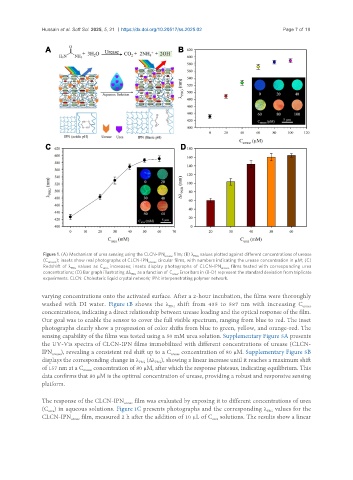
                Figure 1. (A) Mechanism of urea sensing using the CLCN-IPN urease  film; (B) λ PBG  values plotted against different concentrations of urease
                (C urease ); insets show real photographs of CLCN-IPN urease  circular films, with numbers indicating the urease concentration in µM; (C)
                Redshift of  λ PBG  values as  C urea  increases; insets display photographs of CLCN-IPN urease  films tested with corresponding urea
                concentrations; (D) Bar graph illustrating Δλ PBG  as a function of C urea . Error bars in (B-D) represent the standard deviation from triplicate
                experiments. CLCN: Cholesteric liquid crystal network; IPN: interpenetrating polymer network.


               varying concentrations onto the activated surface. After a 2-hour incubation, the films were thoroughly
               washed with DI water.  Figure 1B shows the  λ  shift from 435 to 587 nm with increasing  C urease
                                                          PBG
               concentrations, indicating a direct relationship between urease loading and the optical response of the film.
               Our goal was to enable the sensor to cover the full visible spectrum, ranging from blue to red. The inset
               photographs clearly show a progression of color shifts from blue to green, yellow, and orange-red. The
               sensing capability of the films was tested using a 50 mM urea solution. Supplementary Figure 5A presents
               the UV-Vis spectra of CLCN-IPN films immobilized with different concentrations of urease (CLCN-
               IPN urease ), revealing a consistent red shift up to a C urease  concentration of 80 µM. Supplementary Figure 5B
               displays the corresponding change in λ  (Δλ ), showing a linear increase until it reaches a maximum shift
                                                     PBG
                                                PBG
               of 157 nm at a C urease  concentration of 80 µM, after which the response plateaus, indicating equilibrium. This
               data confirms that 80 µM is the optimal concentration of urease, providing a robust and responsive sensing
               platform.


               The response of the CLCN-IPN urease  film was evaluated by exposing it to different concentrations of urea
               (C ) in aqueous solutions. Figure 1C presents photographs and the corresponding λ  values for the
                                                                                           PBG
                 urea
               CLCN-IPN  urease  film, measured 2 h after the addition of 10 µL of C  solutions. The results show a linear
                                                                         urea

