


Page 107 - Read Online
P. 107
Page 10 of 19                        Hussain et al. Soft Sci. 2025, 5, 21  https://dx.doi.org/10.20517/ss.2025.02

               color for the sensor film, as the physiological concentration of glucose in sweat is typically around 1 mM. By
               tuning the sensor’s starting color to green, we ensured that normal glucose levels would not cause a large
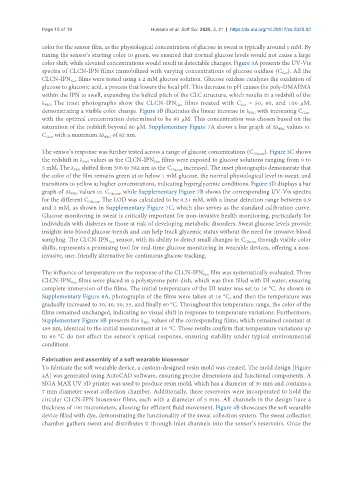
               color shift, while elevated concentrations would result in detectable changes. Figure 3A presents the UV-Vis
               spectra of CLCN-IPN films immobilized with varying concentrations of glucose oxidase (C ). All the
                                                                                                Gox
               CLCN-IPN  films were tested using a 2 mM glucose solution. Glucose oxidase catalyzes the oxidation of
                         Gox
               glucose to gluconic acid, a process that lowers the local pH. This decrease in pH causes the poly-DMAEMA
               within the IPN to swell, expanding the helical pitch of the CLC structure, which results in a redshift of the
               λ . The inset photographs show the CLCN-IPN  films treated with C  = 50, 80, and 100  µM,
                PBG
                                                                                  Gox
                                                            Gox
               demonstrating a visible color change. Figure 3B illustrates the linear increase in λ  with increasing C ,
                                                                                     PBG
                                                                                                       Gox
               with the optimal concentration determined to be 80 µM. This concentration was chosen based on the
               saturation of the redshift beyond 80 µM. Supplementary Figure 7A shows a bar graph of Δλ  values vs.
                                                                                               PBG
               C , with a maximum Δλ  of 82 nm.
                 Gox
                                    PBG
               The sensor’s response was further tested across a range of glucose concentrations (C Glucose ). Figure 3C shows
               the redshift in λ  values as the CLCN-IPN  films were exposed to glucose solutions ranging from 0 to
                             PBG
                                                     Gox
               3 mM. The λ  shifted from 500 to 582 nm as the C Glucose  increased. The inset photographs demonstrate that
                          PBG
               the color of the film remains green at or below 1 mM glucose, the normal physiological level in sweat, and
               transitions to yellow at higher concentrations, indicating hyperglycemic conditions. Figure 3D displays a bar
               graph of Δλ  values vs. C Glucose , while Supplementary Figure 7B shows the corresponding UV-Vis spectra
                         PBG
               for the different C Glucose . The LOD was calculated to be 0.31 mM, with a linear detection range between 0.9
               and 2 mM, as shown in Supplementary Figure 7C, which also serves as the standard calibration curve.
               Glucose monitoring in sweat is critically important for non-invasive health monitoring, particularly for
               individuals with diabetes or those at risk of developing metabolic disorders. Sweat glucose levels provide
               insights into blood glucose trends and can help track glycemic status without the need for invasive blood
               sampling. The CLCN-IPN  sensor, with its ability to detect small changes in C Glucose  through visible color
                                      Gox
               shifts, represents a promising tool for real-time glucose monitoring in wearable devices, offering a non-
               invasive, user-friendly alternative for continuous glucose tracking.

               The influence of temperature on the response of the CLCN-IPN  film was systematically evaluated. Three
                                                                     Gox
               CLCN-IPN  films were placed in a polystyrene petri dish, which was then filled with DI water, ensuring
                         Gox
               complete immersion of the films. The initial temperature of the DI water was set to 16 °C. As shown in
               Supplementary Figure 8A, photographs of the films were taken at 16 °C, and then the temperature was
               gradually increased to 30, 40, 50, 55, and finally 60 °C. Throughout this temperature range, the color of the
               films remained unchanged, indicating no visual shift in response to temperature variations. Furthermore,
               Supplementary Figure 8B presents the λ  values of the corresponding films, which remained constant at
                                                 PBG
               489 nm, identical to the initial measurement at 16 °C. These results confirm that temperature variations up
               to 60 °C do not affect the sensor’s optical response, ensuring stability under typical environmental
               conditions.

               Fabrication and assembly of a soft wearable biosensor
               To fabricate the soft wearable device, a custom-designed resin mold was created. The mold design [Figure
               4A] was generated using AutoCAD software, ensuring precise dimensions and functional components. A
               SIGA MAX UV 3D printer was used to produce resin mold, which has a diameter of 30 mm and contains a
               7 mm diameter sweat collection chamber. Additionally, three reservoirs were incorporated to hold the
               circular CLCN-IPN biosensor films, each with a diameter of 5 mm. All channels in the design have a
               thickness of 100 micrometers, allowing for efficient fluid movement. Figure 4B showcases the soft wearable
               device filled with dye, demonstrating the functionality of the sweat collection system. The sweat collection
               chamber gathers sweat and distributes it through inlet channels into the sensor’s reservoirs. Once the

