


Page 58 - Read Online
P. 58
Page 6 of 11                             Yue et al. Soft Sci 2023;3:13  https://dx.doi.org/10.20517/ss.2023.02


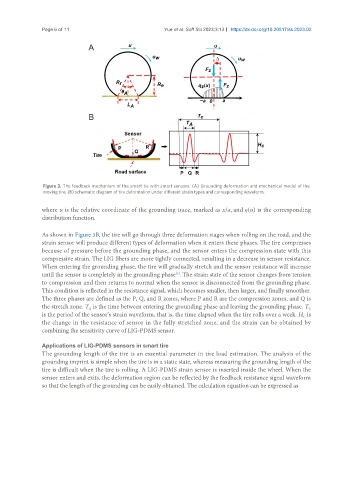
                Figure 3. The feedback mechanism of the smart tie with smart sensors. (A) Grounding deformation and mechanical model of the
                moving tire; (B) schematic diagram of tire deformation under different strain types and corresponding waveform.

               where u is the relative coordinate of the grounding trace, marked as x/a, and η(u) is the corresponding
               distribution function.


               As shown in Figure 3B, the tire will go through three deformation stages when rolling on the road, and the
               strain sensor will produce different types of deformation when it enters these phases. The tire compresses
               because of pressure before the grounding phase, and the sensor enters the compression state with this
               compressive strain. The LIG fibers are more tightly connected, resulting in a decrease in sensor resistance.
               When entering the grounding phase, the tire will gradually stretch and the sensor resistance will increase
                                                            [1]
               until the sensor is completely in the grounding phase . The strain state of the sensor changes from tension
               to compression and then returns to normal when the sensor is disconnected from the grounding phase.
               This condition is reflected in the resistance signal, which becomes smaller, then larger, and finally smoother.
               The three phases are defined as the P, Q, and R zones, where P and R are the compression zones, and Q is
               the stretch zone. T  is the time between entering the grounding phase and leaving the grounding phase. T
                                                                                                         C
                               A
               is the period of the sensor’s strain waveform, that is, the time elapsed when the tire rolls over a week. H  is
                                                                                                       C
               the change in the resistance of sensor in the fully stretched zone, and the strain can be obtained by
               combining the sensitivity curve of LIG-PDMS sensor.
               Applications of LIG-PDMS sensors in smart tire
               The grounding length of the tire is an essential parameter in tire load estimation. The analysis of the
               grounding imprint is simple when the tire is in a static state, whereas measuring the grounding length of the
               tire is difficult when the tire is rolling. A LIG-PDMS strain sensor is inserted inside the wheel. When the
               sensor enters and exits, the deformation region can be reflected by the feedback resistance signal waveform
               so that the length of the grounding can be easily obtained. The calculation equation can be expressed as

