


Page 56 - Read Online
P. 56
Page 4 of 11                             Yue et al. Soft Sci 2023;3:13  https://dx.doi.org/10.20517/ss.2023.02


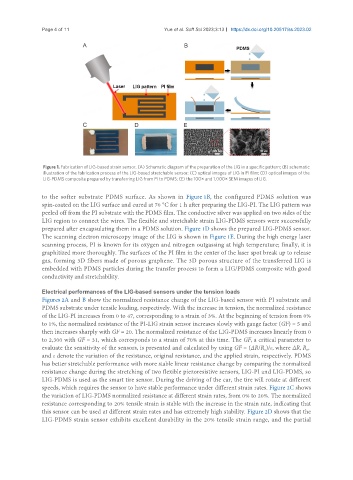
                Figure 1. Fabrication of LIG-based strain sensor. (A) Schematic diagram of the preparation of the LIG in a specific pattern; (B) schematic
                illustration of the fabrication process of the LIG-based stretchable sensor; (C) optical images of LIG in PI film; (D) optical images of the
                LIG-PDMS composite prepared by transferring LIG from PI to PDMS; (E) the 100× and 1,000× SEM images of LIG.


               to the softer substrate PDMS surface. As shown in Figure 1B, the configured PDMS solution was
               spin-coated on the LIG surface and cured at 70 °C for 1 h after preparing the LIG-PI. The LIG pattern was
               peeled off from the PI substrate with the PDMS film. The conductive silver was applied on two sides of the
               LIG region to connect the wires. The flexible and stretchable strain LIG-PDMS sensors were successfully
               prepared after encapsulating them in a PDMS solution. Figure 1D shows the prepared LIG-PDMS sensor.
               The scanning electron microscopy image of the LIG is shown in Figure 1E. During the high energy laser
               scanning process, PI is known for its oxygen and nitrogen outgassing at high temperature; finally, it is
               graphitized more thoroughly. The surfaces of the PI film in the center of the laser spot break up to release
               gas, forming 3D fibers made of porous graphene. The 3D porous structure of the transferred LIG is
               embedded with PDMS particles during the transfer process to form a LIG/PDMS composite with good
               conductivity and stretchability.


               Electrical performances of the LIG-based sensors under the tension loads
               Figures 2A and B show the normalized resistance change of the LIG-based sensor with PI substrate and
               PDMS substrate under tensile loading, respectively. With the increase in tension, the normalized resistance
               of the LIG-PI increases from 0 to 47, corresponding to a strain of 3%. At the beginning of tension from 0%
               to 1%, the normalized resistance of the PI-LIG strain sensor increases slowly with gauge factor (GF) = 5 and
               then increases sharply with GF = 20. The normalized resistance of the LIG-PDMS increases linearly from 0
               to 2,300 with GF = 31, which corresponds to a strain of 70% at this time. The GF, a critical parameter to
               evaluate the sensitivity of the sensors, is presented and calculated by using GF = (∆R/R )/ε, where ∆R, R ,
                                                                                                        0
                                                                                          0
               and ε denote the variation of the resistance, original resistance, and the applied strain, respectively. PDMS
               has better stretchable performance with more stable linear resistance change by comparing the normalized
               resistance change during the stretching of two flexible piezoresistive sensors, LIG-PI and LIG-PDMS, so
               LIG-PDMS is used as the smart tire sensor. During the driving of the car, the tire will rotate at different
               speeds, which requires the sensor to have stable performance under different strain rates. Figure 2C shows
               the variation of LIG-PDMS normalized resistance at different strain rates, from 0% to 20%. The normalized
               resistance corresponding to 20% tensile strain is stable with the increase in the strain rate, indicating that
               this sensor can be used at different strain rates and has extremely high stability. Figure 2D shows that the
               LIG-PDMS strain sensor exhibits excellent durability in the 20% tensile strain range, and the partial

